


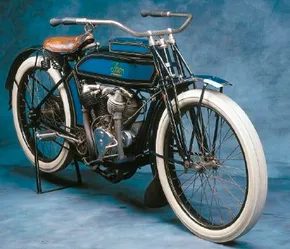
Thor is more than just a dusty name in a museum. It was the driving force behind the motorcycle boom. Most riders are familiar with either Indian or Harley-Davidson. Few people know about Thor. The company started manufacturing the heart of Indiann motorcycles in 1902. It owned the Aurora Automatic Machinery Company.
The Thor motor also works in the Reading Standard bike. Sears sold Thor-powered cycles. This brand offers more than just parts. It defined the development of early motorcycles. These machines are secondary to the power plant.
When Thor Went Solo
The cooperation with the Indianns ended in 1907. Thor then began to manufacture its own complete motorcycles. Early models retained the single-cylinder engine that was in production for five years. It’s very simple. It worked.
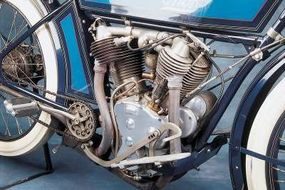
Then in 1910 the V-twin was introduced. This is not a complete redesign. This is the same engine block, but with another cylinder bolted on. But look at the geometry.
The motor is not installed in a vertical position. Lean forward. The rear cylinder is positioned vertically. It’s not just about style. This creates space behind the engine. There is plenty of space for attaching the magneto. The carburetor is also installed there.
1913 Design Revolution
By 1913, Thor changed direction again. Introduced a new V-twin model. This reverts to the traditional setup. A 76 cubic inch displacement is serious.
It has a racing pedigree. Thor bikes won races. But they are not the dominant force. Indian and Harley-Davidson cast a long shadow. Thor was always a competitor. Not the king.
The End of the Line
Competition killed Thor. Just like it killed many small manufacturers at the time. In 1917, the last motorcycle rolled off the production line. Aurora Automatic Machinery Company pivoted. A shop specializing in power tools. Appliances took over.
This tradition lives on in the engines manufactured by the company. Not the frames it stamped.
Why Thor is important today
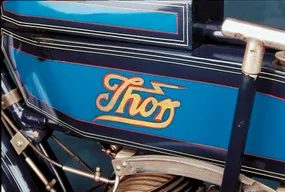
You might be wondering why the 1914 Thor is relevant now. It represents a significant change. From the reliability of a single cylinder to the refinement of a V-twin. This shows how engine suppliers dominated the industry before vertical integration became the norm.
Thor engines are very popular among restorers. They are rare. they are unique. Finding a 1914 model is a hunt. The slanted V-twin design was unique for the era.
See the 1914 model
The 1914 Thor symbolizes this transitional period. It has familiar single cylinder roots. However, the seeds of the future V-twin were also hidden there. The details are subtle. The design is bold.
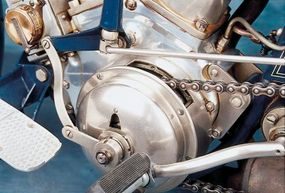
Restoring one requires patience. Parts are hard to come by. Installing the magneto is difficult. But the ride is worth it. The sound is unmistakable.
Where can I get more information?
If you like this kind of history, dig deeper. More pictures can be found in the Classic Motorcycle archive. “How Motorcycles Work” explains the technology. Other retro brands have similar stories.
The 1914 Thor is more than a machine. This is a chapter in a larger story. Something that is often overlooked. But it shouldn’t be.
Final thoughts
Thor’s engine designs influenced the

The end of the motorized bicycle era
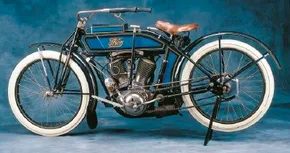
By 1914, the line between pedal bikes with a motor strapped to it and true motorcycles was blurred. 1914 Thor motorcycle sits on this watershed. This is no longer just a novelty. This is a machine that doesn’t just fit an engine into a frame, it works.
The early models were big. It feels like a bike that has been forced to work harder. Thor changes that. It turned the tables. Technology has changed. The focus shifts to stability and control. This is not about adding a motor to an old bike. It’s about building a platform that can withstand the power.
Consider the context. The beginning of the 20th century was a chaotic time. Manufacturers do tests. There are also bicycles that look like tricycles. Others have small wheels. Thor offers a more advanced path. This marked the end of the original “motorized bicycle” phase.
This switch is important. Riders don’t just move forward. They want a machine that feels grounded. The 1914 model offered this. Yes, this is a transitional model. But it is also a declaration. Motorcycles have grown. Thor understood for the first time what this meant.
Stabilization technology
The key is inside the frame. Previous versions often suffer from poor flex and handling. Thor solves this problem. It has a sturdier structure. Improved geometry. This makes fast driving safer. This also reduces the gamble of turning.
“In 1914, Thor represented a decisive step away from the fragile framework of the past.”
It’s not just about strength. It’s a matter of precision. Improved component matching. In many configurations, the engine is located lower. This lowers your center of gravity. Riders feel more connected to the road. The experience changes. It’s no longer about surviving the journey, but about enjoying the journey.
Why this change matters today
We often think of early motorcycles as charming relics. The 1914 Thor is a reminder that evolution is not linear. This is a series of experiments. Some failed. Others like this person set the standard. The trend towards purposeful motorcycle design influenced all subsequent brands.
Thor did not invent the modern motorcycle. But it helps define the category. This shows that motorized bike need their own identity. It’s not a disguised bike. motorbike. This distinction is important. It enables specialization. Engineers can focus on suspension, braking and handling without affecting the core design.
This legacy lives on. All modern bicycles exist because of engineers who realized that an engine needs a proper home. The 1914 Thor was part of that realization. This is a step towards the machine we know and love. The road from motorized bicycles to real motorcycles is long. But the 1914 Thor was an important milestone. It turns out that the road ahead is worth building.



Keep digging
Want more? The whole world on two wheels awaits.
View archive.
classic bike.
How a motorcycle works.
Other classic bikes.


