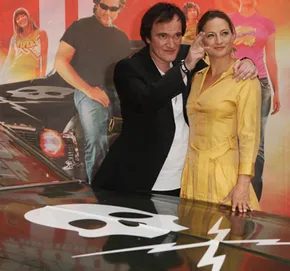
The 1970 Chevrolet Nova in Death Proof isn’t just a car. It is a weapon. Stuntman Mike drives it with the sole intent of breaking things and people. He isn’t worried about the pedestrians he turns into roadkill. He isn’t worried about the passengers in his passenger seat. He only cares about himself. That is why he has installed a roll cage and a five-point harness on the driver’s side. It is a crude, brute-force approach to survival. It works in the movie. It looks cool. It is also completely fictional.
Real safety doesn’t come from steel beams and shatter-proof glass. It comes from technology.
Engineers are not building tanks. They are building brains. The goal is no longer just to survive a crash. It is to never have the crash happen in the first place. This shift changes everything about how we define a death-proof car. The muscle car era is over. The future looks more like a high-end Volvo.
The Volvo Promise and PReVENT
Volvo isn’t playing around. The Swedish manufacturer is a working member of the PReVENT safety research group. Their public goal is specific: an injury-proof car by 2020. They aren’t promising invincibility. They are promising that the vehicle will intervene before the driver becomes a statistic.
Luxury brands like BMW and Lexus are already running these experiments. The tech is expensive. It will sit in premium vehicles first. Economy cars will get the updates later. That is how innovation trickles down. It always does.
Connecting the Dots
The components already exist. You have seen them. Forward-collision warning. Automatic emergency braking. Blind-spot monitoring. Lane-keep assist. These systems work in isolation. They are good. But they are not yet a unified intelligence.
The challenge isn’t inventing new sensors. It is tying the existing ones together into a single, reactive system. A car that thinks faster than a human. A car that sees danger before the driver’s brain even registers the threat.
This is where the real question lies. Why will these systems be able to handle accidents better than the person behind the wheel?
That answer is coming next.

The Reaction Gap and the Rise of Autonomous Intervention
Humans don’t think when danger hits. We freeze.
This physiological shutdown is fatal on the highway. Research indicates the average driver takes about 1.1 seconds to react to a collision before hitting the brakes. That delay feels negligible until you do the math. Reducing impact speed by just 10 mph cuts highway fatality rates in half. In that sliver of time, a car traveling at 60 mph covers nearly 90 feet. Uncontrolled.
The stats are worse than you’d expect. In 50 percent of rear-end collisions, the incoming driver never touches the brake pedal at all. They are simply too slow to process the threat.
Auto safety engineers are tired of waiting for human reflexes to catch up. Their premise is simple: remove the emotional, paralyzed human from the decision loop. If the car calculates the trajectory of an impending crash itself, accident rates should plummet. The goal is a “death-proof” vehicle.
Engineering the Unstoppable Vehicle
“Death-proof” is a hyperbolic term. Systems fail. Nothing is perfect. But the PReVENT project is pushing the boundary of what’s mechanically possible. They aren’t just adding bells and whistles. They are reimagining the role of digital safety features.
Current systems in modern cars are passive advisors. They warn you. The PReVENT approach is active. It thinks for you.
Take the precollision prevention system. It already exists in many luxury models. Lasers, infrared sensors, and cameras scan the road. When an obstacle appears, the car flashes a warning light and sounds an alarm. It pre-tensions seatbelts, primes the airbags, and increases brake pressure. Some systems will even auto-brake. But it stops there. It waits for you to act.
Then there is blind spot detection. These sensors monitor the lanes you can’t see. They beep to tell you a car is merging. They inform. They do not intervene.
PReVENT wants to bridge that gap. The objective is to have the vehicle take physical control when a potential threat becomes a real one. The onboard computer analyzes the situation from every angle. While the driver is staring blankly in terror, the car is executing evasive maneuvers.
Navigating the Chaos
The PReVENT vision relies on data integration. It pulls information from satellite navigational maps to anticipate dangerous road geometry, like hairpin curves or steep declines. It monitors blind spots for pedestrians, cyclists, and other vehicles. It tracks the speed and direction of every object in the vicinity.
With this holistic view, the car calculates the optimal escape route. Is it braking? Swerving? A combination of both?
The complexity of these decisions is staggering. Future navigation algorithms may need to make split-second ethical risk assessments. Should the car swerve left, risking a collision with a squirrel, to avoid hitting a woman pushing a stroller on the right? These are not hypotheticals. They are imminent coding challenges.
The Injury Reduction Potential
A truly accident-free car might never exist. Physics is unforgiving. But a car designed specifically to minimize injury is highly plausible.
Consider the scale of the problem. Globally, about 1.2 million people die in car wrecks each year. That number is horrific. But the number of injured is far higher. Approximately 50 million people suffer non-fatal injuries from vehicle crashes worldwide. Fatalities grab the headlines, but injuries dominate the statistics.
If PReVENT’s technology is refined and widely adopted, both numbers should drop significantly. The shift from warning to intervention changes the entire dynamic of road safety. It turns the car from a passive metal box into an active participant in survival.
The Road Ahead
This isn’t just about stopping crashes. It’s about surviving them. The integration of GPS data, sensor arrays, and autonomous braking creates a safety net that human reaction times can never match. We are moving toward a future where the car doesn’t just tell you to look out. It looks out. And when that’s not enough, it acts.
The technology is still maturing. Ethical dilemmas around algorithmic decision-making remain unresolved. But the direction is clear. We are outsourcing the reflexes we don’t have.