


Most drivers think of choosing a car as an either-or choice. You can either use the clutch pedal and gear or let the automatic do the heavy lifting with a torque converter and planetary gear. However, there is also a middle ground. This is often called a semi-automatic, automatic manual or clutchless stick. The technical term is dual clutch transmission.
Racing teams have used sequential manual transmissions for many years. With a commercially available car? This is newer. The industry defines this segment with one specific model: Direct Shift Transmission (DCT). We look at how these machines work, how they compare to traditional automatic and manual machines, and why some experts say this is the future of shifting.
Do it or let it go
The DCT effectively functions as two manual transmissions stacked in the same housing. To understand its importance, we need to remember how standard manuals work. Press the clutch. This can cause the engine to disengage from the transmission, cutting power. Move the lever to slide the cog to the next gear size. The synchronizer engages the gears and stops grinding. Release the clutch. Power has been restored.
This creates a gap. Turn off the power and turn it on again. This confusion can cause “shock load”. A professional driver can throw passengers off while changing.
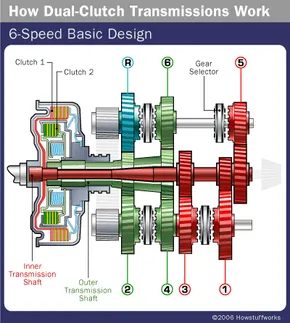
A dual clutch setup uses two clutches but does not require a pedal. As in a normal car, complex electronics and hydraulics control the clutch, but the clutch operates independently. One clutch handles the odd-numbered gears (1st, 3rd, 5th and reverse). The second controls even gears: 2nd, 4th and 6th.
This configuration allows shifting without disturbing the transmission of power to the transmission. It happens in order.
Double clutch drive shaft
This project is based on two concentric axes. The outer shaft uses even gears. The inner shaft uses an odd number of gears. They rotate independently.
When you engage third gear, engine power flows through first clutch to the odd-numbered shaft. But the second clutch already selects the 4th gear. The gears are in place. Sync works. All you need is torque.
When the car passes the exchange point, the electronics closes the second clutch and opens the first. The power is immediately transferred from the odd shafts to the even shafts. There are no gaps. No shock.
That’s why the DCT feels faster. Eliminates torque interruptions common in traditional manuals. But it’s not just about speed. It’s all about efficiency. Unlike the fluid coupling of an automatic torque converter, it has a direct mechanical connection. Take advantage of the efficiency of manual operation and the convenience of automation.
However, it is not without its quirks. The hydraulic system can feel unstable at low speeds. Engaging the clutch requires precise timing. If the software hesitates, you’ll feel it. This is a compromise. Replaces the rod’s purely mechanical connection with a complex dual hydraulic circuit.
The result is a transmission that shifts incredibly quickly and with almost brutal efficiency. It’s a compromise between driver involvement and comfort. Whether the complexity of maintenance is worth it is a big question for today’s buyers.

Dual clutch architecture description
The standard guide is simple. This is the input shaft. Lift the pedal, take the gear out, shift and put it back in. It is linear. This is as expected. It is also very slow.
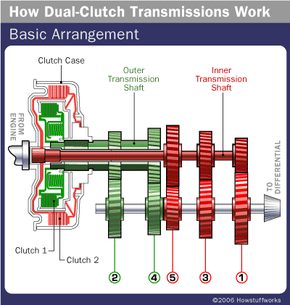
A dual-clutch transmission (DCT) cheats this process by sharing the load. It uses two concentric shafts instead of one set of gears.
Think of it like a Russian Matryoshka doll. The outer shaft is hollow. There is a fixed inner shaft inside. These rotate independently and are controlled by separate clutches.
The role distribution is special. The outer hollow shaft handles even gears, i.e. 2nd and 4th gears. The internal solid shaft has an odd gears (1st, 3rd and 5th).
The secret is not only the equipment. Independent clutch control.
This setting allows one clutch to use one set of gears while the other clutch pre-selects the next gear. When you change gears, the clutch roles swap almost instantly. There is no power loss. No delays. It simply transfers the torque seamlessly.
Traditional manuals cannot reproduce this. There is only one clutch plate. You have to remove everything to change gears. DCT keeps half of the transmission running while the other half prepares for the next phase. That’s why the change seems like lightning. Continuous power supply. Zero interruptions.

The mechanism behind the change
Since dual-clutch transmissions (DCTs) share the same DNA as traditional automatic transmissions, you might think that a torque converter is needed to bridge the gap between engine and transmission. This is not true. Gone are the big hydraulic connectors.
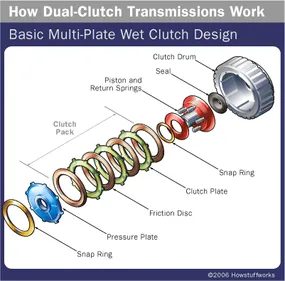
Instead, modern dual clutch transmissions rely on wet multi-plate clutches.
Think of a “wet” clutch as a sandwich soaked in oil. Friction plates are soaked in lubricant and have two important functions: reducing friction and, more importantly, controlling the intense heat generated during shifting. This thermal management allows these units to handle the brutal torque of high-performance engines without melting into slag.
While some engineers have tinkered with dry clutch setups for DCT systems (mimicking the simple exposed plate of a manual transmission), all current production cars that follow the DCT architecture use wet clutches.
This is a proven formula. You may have seen this technique before with just two wheels. Many high performance motorcycles use single disc clutches for the same reasons: tightness and heat dissipation. The difference is in scale. The automatic version is designed to withstand extreme use, changing gears in milliseconds while keeping the drivetrain well-cooled during daily commutes or weekend routes.
This model selection is not just for cooling. It’s a matter of precision. The wet clutch provides smooth engagement at low speeds and reduces the vibration that plagued early DCT attempts. For drivers, this means that the car feels more like a fine-tuned device than a robot trying to imitate a human.
Why is it wet? Heat problem
The main reason for wet design is simple physics. A dual-clutch transmission changes gears by engaging and disengaging the clutch while the engine is connected to the wheels. This creates friction.
A dry clutch dissipates heat into the air, similar to a regular Honda Civic manual. It is very light. they are very effective. But it can’t handle continuous hard driving and stop-and-go traffic without overheating.
Wet clutches solve this problem by using transmission fluid as a coolant. The liquid circulates around the plates, absorbs heat and transports it to the cooler. This allows the DCT to:
- Supports higher torque loads
- Last longer without wearing out
- Achieves a steady state from a stop.
This is a trade-off. You lose some efficiency due to liquid resistance, but you gain durability and refinement. For a powerful car, this is a deal you can accept without hesitation.
Real world impact
So why is this important to you?
That’s because a wet multi-plate clutch is the secret to a dual-clutch transmission that’s suitable for everyday driving. Early dual-clutch systems, such as the first-generation Ford Powershift and early Volkswagen dry-clutch DSG engines, were notorious for failures. It feels cheap. It breaks often.
With a wet clutch, the story is different. This allows manufacturers such as Porsche, Audi and BMW to equip their high-powered, rear-wheel drive machines with DCT. For example, Porsche PDK is definitely the gold standard. It uses a wet clutch to handle the massive torque of the 911 flat-six and shifts so quickly it’s almost imperceptible. this

Joining and exiting mechanisms
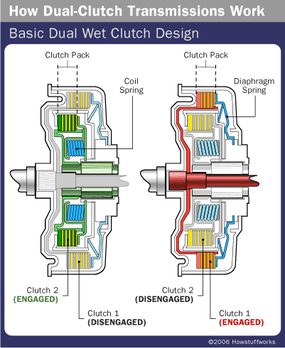
Just like the lifeblood of a torque converter, the lifeblood of a wet multi-plate clutch is hydraulic pressure. But inside the clutch piston, this fluid plays a special role. When the system is activated, pressure builds up inside the piston. This force presses on the coil spring and compresses it. The spring bends and forces the stack of clutch plates and friction plates against the stationary pressure plate.
This is where metals and mathematics meet. Friction plates are not just flat plates. The internal teeth are designed to hit the grooves of the clutch drum. If the geometry is wrong, the transmission will stop. The drum is at the other end of the assembly and is connected directly to the gearbox. Its function is simple: transfer power to rotate the gears. Audi didn’t just include springs in its dual-clutch model. I used a combination of a small coil spring and a large diaphragm spring. Why? It can withstand high torques without melting or slipping.
Resignation is the opposite. Reduce fluid pressure. Spring is relaxing. The clutch pack loses its clamping force. The power stops. It is very beautiful. It is very fast. But can it be trusted? We’ll find out soon.
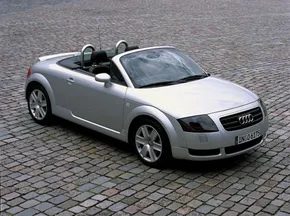

It’s becoming increasingly clear why DCT is technically an automated manual. It is basically a regular shifter. It has input shaft, counter shaft, gear, synchronizer and clutch. The only thing missing is a foot pedal. Computers, solenoid valves and hydraulic systems handle the heavy lifting. However, you can call the shots. The paddle, button or lever itself tells the computer when to change gears.
The real win here is the feeling of driving.
Gear speed and driver control
Upshifting takes about 8 milliseconds. It’s early. Many drivers swear it has the most dynamic acceleration at the moment. It also went very smoothly. You won’t experience the usual harsh acceleration or shifting shock of traditional manual transmissions and some torque converter automatic transmissions.
Your choice? You choose.
DCT gives the driver the freedom to choose whether to control the gears or let the computer do all the work.
Why not try searching for devices yourself? Good luck. Do you want a computer that makes decisions for you? It can do it better and faster than most human hands.
Fuel efficiency and market realities
The fuel economy makes interesting figures. The flow of power from the engine to the wheels is unhindered during gear changes, which greatly increases efficiency. Experts suggest that the 6-speed DCT offers a 10% relative increase in fuel efficiency over a conventional 5-speed automatic transmission. For a performance car, this is a huge advantage.
Manufacturers are working on DCT technology, but not all are actively working on it. Changing production lines to handle these complex devices is expensive. Additional fees can increase the list price, which may scare off budget-minded buyers who just want reliable transportation.
CVT options
Other car manufacturers are also investing heavily in various technologies. Continuously variable transmissions (CVTs) are the main contenders. Continuously adjust gear ratios with a pulley system and belt or chain. There are no clear steps. Very smooth acceleration.
The CVT reduces shift shock and significantly improves fuel efficiency. However, there is one big drawback. These cannot handle the high torque demands of real performance machines.
DCT does not have this limitation. They are designed for high-torque and high-power environments. In Europe, manual transmissions continue to dominate in terms of driveability and economy, with predictions that dual-clutch transmissions could capture 25% of the market. In contrast, by 2012, only about one percent of cars manufactured in Western Europe are expected to have a CVT.
Things are changing. We have looked at mechanisms and market forces. Next, we look back at DCT’s history and look to the future.

Adolphe Kégresse is more than just tinkering with gears. He was the engineer who actually invented the dual clutch transmission. You might know him best from the Halftrack, a weird hybrid car with endless rubber surfaces. It looks like a tank but moves like a ship. Kégresse uses these trucks to conquer off-road terrain. In 1939 he had a new idea. He wanted to create a dual clutch transmission for the legendary Citroën “Traction” cars. Business politics got in the way. The project died there.
Decades later, the concept has not disappeared. Audi and Porsche saw the potential. They first started using it in racing cars.
The benefits of Porsche PDK
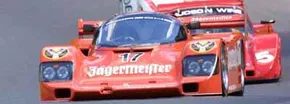
Porsche Dual Clutch (or PDK) stands for the name in the brochure. Originally it was a semi-automatic paddle shifter. Designed for speed, not comfort. The 956 and 962C racing cars are equipped with this technology.
In 1986, the 962 took the checkered flag at the Monza 1000km World Championship of Sports Prototypes. This was the first victory for a car equipped with PDK. It’s more than just a trophy. This shows that the dual clutch concept also works under pressure.
Audi Pikes Peak Victory
Audi also has its moments. In 1985, the Sport Quattro S1 rally car climbed Pikes Peak. The height of the mountain is 4300 meters. This is a tough test for any engine. This car uses a dual clutch transmission to win.
There are two manufacturers. Two different eras. However, the core technology remains the same.
From the truck to the street
Commercialization of this technology has been difficult. Until recently, this was not possible in everyday cars. Volkswagen has made its operations more efficient. They licensed BorgWarner’s DualTronic technology. This makes the equipment affordable and reliable enough for street use.
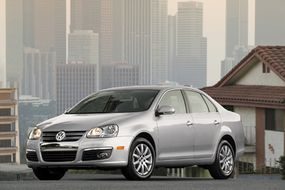
If you look at European cars with DCT, you will see that the list is quite long. The Volkswagen Beetle has it. The same goes for golf. It also uses Touran and Jetta. Audi installs these on its TT and A3 models. Skoda equips the Octavia. Seat has not forgotten the Altea, Toledo and Leon.
The change happened quietly. You don’t have to be a mechanic to notice this. Conversion is faster. Smoother. The gap between racing technology and the daily commute is closing. But what is the design behind it? It’s still very complicated. It’s still fascinating. And it’s still evolving.

Ford enters the dual clutch field
Ford didn’t back down. The manufacturer is officially working to develop dual-clutch technology, leveraging its European operations and a 50-50 joint venture with transmission specialist GETRAG-Ford. They presented the prototype at the 2005 Frankfurt International Motor Show. This is a 6 speed gearbox.
The production reality lags behind the hype. The first generation of Powershift-equipped vehicles appeared on the market about two years after their debut. The technology is real. It just stretches the timeline.
How a dual clutch transmission works
The mechanism is simpler than the marketing suggests. A dual clutch configuration uses two separate clutches. One controls odd gears. The second deals with even gears.
These units operate independently. This means that there is no need for a clutch pedal. Computer-coordinated shifts. Result? The shift takes a few milliseconds.
For the driver, the experience is seamless. Acceleration is smoother. The torque is not interrupted when changing gears.
Advantages compared to traditional automatic devices
Why a dual clutch system? The main attraction is efficiency. They are usually more fuel efficient than traditional automatic transmissions. The absence of fluid coupling losses helps.
The driving experience has also been improved. Shifts are faster and more accurate. It mimics manual operation and requires no manual intervention.
Is it better than a standard automatic transmission? For many people, yes. Fuel efficiency improves. It can shift faster. It’s kind of a hybrid.
Automatic or manual?
Technically, it is a computer-controlled manual transmission. However, it is functionally automatic. There are no pedals. Almost no controller input is required.
So is a dual clutch transmission an automatic transmission or a manual transmission? It has a middle ground. It uses manual gear selection logic, but it happens automatically.
Driving dynamics
Can it be handled like a traditional automatic transmission? Not exactly. The gearbox requires certain driving habits, but the computer takes care of the gears.
Problems can occur if you push it too hard or leave it in traffic for too long without proper cooling. To keep the system healthy, we must continue to participate in the shifting process. It’s not a “set it and forget it” type like an automatic torque converter.
“You still have to shift yourself for the transmission to work properly.”
This nuance is important. It’s more than just a gearbox. This system requires some driver input.
Detailed information about DCT
For a deeper understanding of transmissions and related automotive technology, check out the resources listed below. The landscape is evolving. The technology is maturing. Ford’s early bet puts them in contention.


