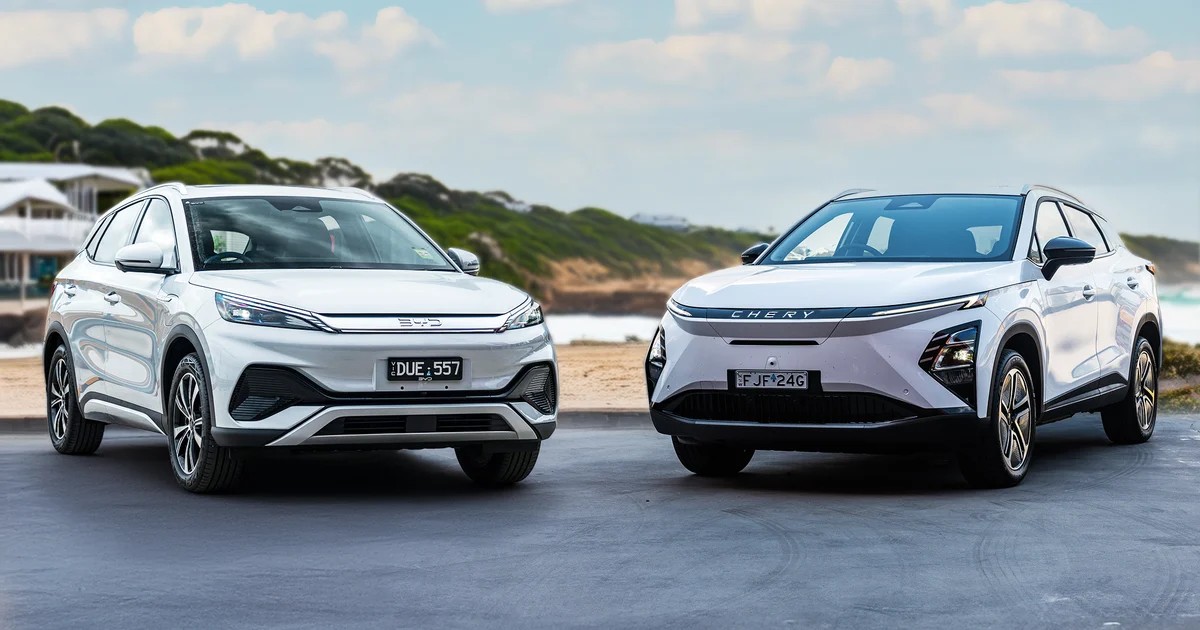
The electric vehicle (EV) market is expanding rapidly, and affordable options are becoming more accessible. As fuel prices climb, many Australian families are seeking cost-effective alternatives. This article breaks down the key differences between two of the most competitive budget-friendly electric small SUVs: the Chery E5 and the BYD Atto 3.
Pricing: Which One Saves You More?
The Chery E5, formerly known as the Omoda E5, starts at $36,990 (plus on-road costs) for the base Urban model, with the higher-spec Ultimate adding another $4,000. BYD’s Atto 3 begins at $39,990 (plus ORCs) for the Essential trim and climbs to $44,990 for the Premium.
Currently, the Chery E5 is the more affordable option at every level. BYD is preparing an updated version of the Atto 3 later this year, but for now, Chery holds the price advantage.
Features: What Do You Actually Get?
Both Chery and BYD offer generous standard equipment for their price points, including:
- 18-inch alloy wheels
- LED headlights and taillights
- Power tailgate
- Panoramic sunroof
- Synthetic leather upholstery
- Electrically adjustable front seats
- Wireless phone charging
- Smartphone connectivity
However, the Chery E5 edges out the Atto 3 with dual-zone climate control, heated rear seats, and a heated steering wheel. While the BYD has a unique rotating 15.6-inch infotainment touchscreen, the Chery features twin 12.3-inch linked displays.
Safety: How Well Do They Protect You?
Both vehicles boast a maximum five-star ANCAP safety rating (from 2022). The Chery excels in child occupant protection (88% vs. BYD’s 84%) and safety assist (83% vs. 80%), while the BYD performs slightly better in adult occupant protection (91% vs. 87%). Both come equipped with essential safety features like:
- 7 airbags
- Autonomous emergency braking
- Adaptive cruise control
- Lane keeping assistance
- 360-degree cameras
Interior Space and Design: Comfort and Style
Both SUVs are similar in size, but the Atto 3 is slightly longer and wider, with a longer wheelbase. Both offer comfortable seating for five, but the Atto 3’s dedicated EV platform provides more rear-seat space and easier access.
However, the Chery E5’s interior design is generally considered more refined and less polarizing than the BYD Atto 3’s unconventional styling, which includes unusual design elements.
Performance: Under the Hood
Both use a permanent magnet synchronous motor with front-wheel drive. The Chery E5 delivers 155kW and 288Nm of torque, while the BYD Atto 3 offers 150kW and 310Nm. Both feature lithium iron phosphate (LFP) batteries.
- Chery E5 : 58.9kWh battery, up to 430km range, 6.6kW AC charging, 130kW DC fast charging.
- BYD Atto 3 : 60.5kWh battery, up to 420km range, 7kW AC charging, 88kW DC fast charging.
The Chery offers slightly faster DC fast charging and a marginally longer driving range.
Cost of Ownership: Long-Term Value
BYD provides a six-year/150,000km vehicle warranty and an eight-year/160,000km battery guarantee with free roadside assistance for the first year. Chery offers a seven-year/unlimited-kilometer vehicle warranty and an eight-year/unlimited-kilometer battery warranty, also with free roadside assistance for the first year. Chery’s service costs are slightly lower over seven years ($1,586 vs. BYD’s $2,291).
Verdict: The Best Budget EV Choice
Both the Chery E5 and BYD Atto 3 are compelling options in the affordable EV segment.
The Chery E5 emerges as the overall winner due to its lower price, competitive features, and longer warranty. It delivers a solid package for budget-conscious buyers seeking a practical electric SUV.