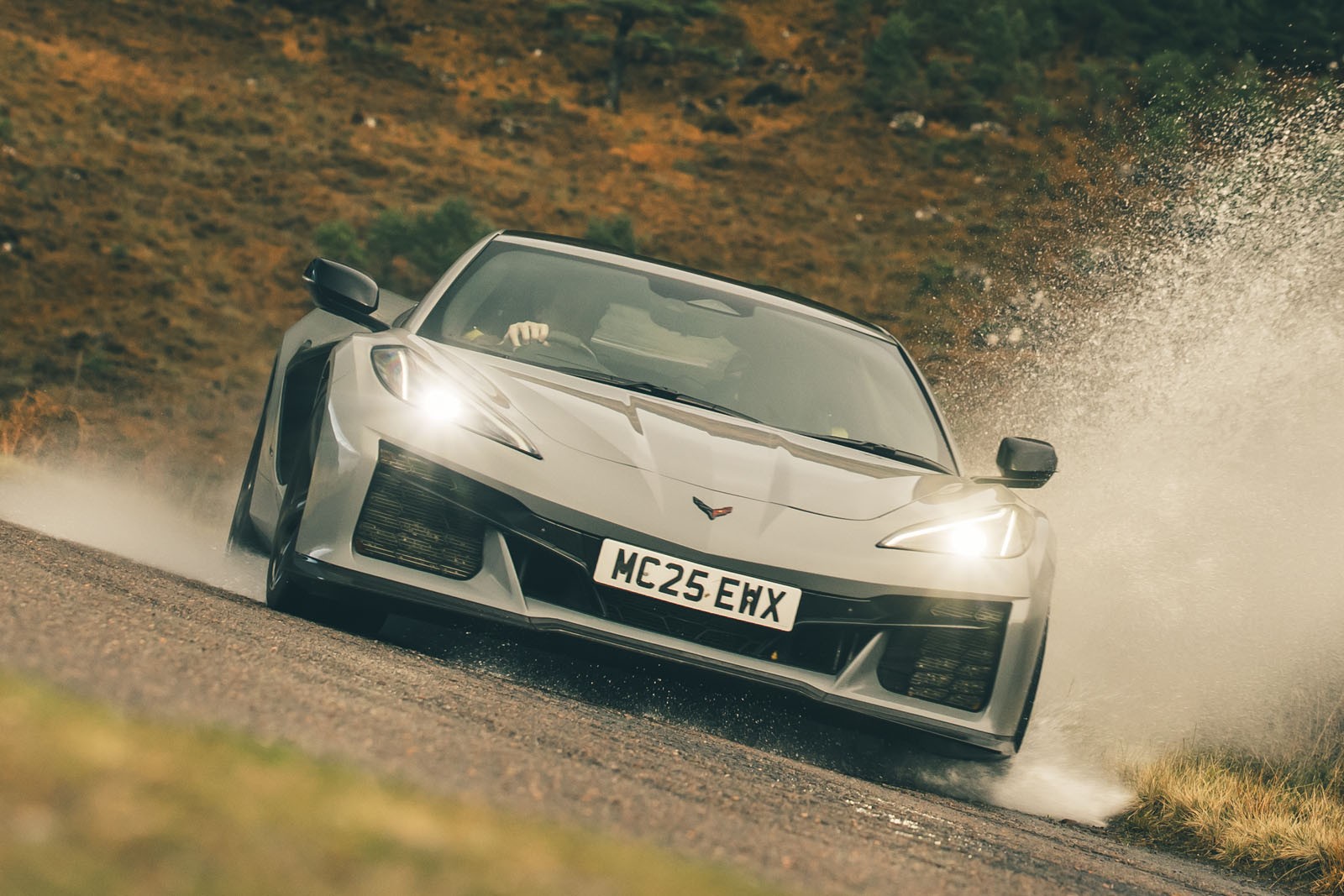
Testing a high-performance machine in perfect conditions is easy; testing it in a deluge is where true character is revealed. To push the limits of the Chevrolet Corvette E-Ray, we headed to Scotland, seeking geological variety and challenging weather. Instead, we found ourselves navigating a near-apocalyptic storm near Gretna, driving through torrential rain and heavy visibility issues.
This extreme environment provided the perfect backdrop to answer a fundamental question: Has the Corvette evolved from a straight-line muscle car into a sophisticated, all-weather supercar?
A Hybrid Twist on a Classic Formula
The E-Ray represents a significant pivot for the C8 generation. While it retains the soul of a traditional American powerhouse, it introduces two major technological shifts: all-wheel drive and electrification.
At its core, the E-Ray remains a purist’s machine, featuring the atmospheric 6.2-litre LT2 V8 producing 482bhp. However, the “magic” happens in the chassis. A small 1.9kWh battery tucked into the car’s spine powers a 160bhp electric motor on the front axle—a component provided by Mitsubishi.
This configuration gives the E-Ray something no other Corvette in its 73-year history has possessed: 4WD capability. This isn’t just about raw power; it’s about traction and stability, making the car far more viable in unpredictable climates like Northern Europe.
Performance Meets Practicality: The GT Test
Before reaching the storm, we put the E-Ray through a 320-mile motorway transit to test its Grand Tourer (GT) credentials. For a car with 634bhp, the results were surprisingly civilized:
-
Efficiency: The car achieved a respectable 32.1mpg, aided by its hybrid system which harvested 4.1kWh of energy during the trip.
-
Refinement: The V8 engine remained a “polite” presence rather than a constant roar,, and the magnetorheological dampers provided a sense of “heavy grace,” smoothing out motorway undulations.
- Interior Comfort: The wraparound cockpit feels premium, and while the GT2 bucket seats offer snug thigh support, the overall ambiance is cozy and well-suited for long-distance travel.
Why This Matters
For decades, the Corvette has faced a reputation hurdle: it was often seen as a “brute” capable of incredible speed in a straight line, but lacking the nuanced handling and all-weather composure of European rivals like the Porsche 911.
By adding an electric front axle, Chevrolet isn’t just chasing electrification trends; they are solving the Corvette’s historical Achilles’ heel—traction. The E-Ray is an attempt to bridge the gap between American muscle and European supercar sophistication, offering a car that can handle a high-speed Autobahn run or a rain-soaked Scottish motorway with equal confidence.
The E-Ray suggests that the Corvette is no longer just a weekend toy for sunny days, but a highly accomplished, mid-engined machine capable of being an “any-occasion” supercar.
Conclusion
The Corvette E-Ray successfully blends its legendary V8 heritage with modern hybrid technology, resulting in a car that is surprisingly efficient, comfortable for long distances, and significantly more capable in adverse weather than its predecessors.