Ford is poised to revive the Fiesta, not as a gasoline-powered icon, but as an affordable electric vehicle for Europe. After discontinuing the model in favor of crossovers, the company will now leverage its partnership with Renault to build a new generation Fiesta EV on the French automaker’s AmpR Small platform. This move highlights a shift in priorities: prioritizing electrification and cost efficiency over traditional combustion engines.
A New Design, Familiar Roots
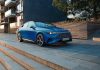
The Fiesta EV will draw heavily from the design language of the Renault R5, adopting a compact profile with short overhangs and an upright windscreen. The front fascia will feature a clean, closed-off grille, while slim headlights and subtle air intakes will minimize visual clutter. The side profile will echo Ford’s radical ‘Start’ concept from 2010, with a gently rising beltline and curvaceous surfacing. The rear will be wider, with horizontal taillight connections and a vertical fog lamp.
Tech-Forward Interior
Inside, the Fiesta EV will boast a tech-laden interior, sharing electronic architecture with Renault, including a dual 10-inch digital instrument cluster and infotainment screen running on Google’s operating system. Material quality will improve, with soft-touch surfaces and recycled fabrics replacing cheaper plastics from previous models. The overall dimensions are expected to be similar to the Renault 5, at 3,922 mm in length, 1,774 mm in width, and 1,498 mm in height.
Performance and Range
The Fiesta EV will trade its former 1.0-liter turbocharged engine for a front-drive, single-motor electric setup, delivering between 120-150 hp. A higher-performance ST variant could arrive later, potentially reaching up to 210 hp. Battery options will include 40 kWh and 52 kWh NMC packs, offering a WLTP range of up to 248 miles. DC fast charging will support speeds up to 101 kW, and the vehicle will include vehicle-to-load and vehicle-to-grid capabilities.
Competition and Timing
The Fiesta EV will compete with rivals such as the Peugeot e-208, Opel Corsa-E, Cupra Raval, Kia EV2, Renault 5 E-Tech, and Volkswagen ID.Polo. Ford is expected to unveil the production version in late 2024 or early 2025. A U.S. launch is unlikely due to tariffs, the model’s small size, and declining EV demand following the end of federal tax credits.
The return of the Fiesta as an EV is a strategic move by Ford to maintain affordability in the rapidly electrifying European market. Leveraging Renault’s platform allows for cost-effective development while still delivering a competitive product.