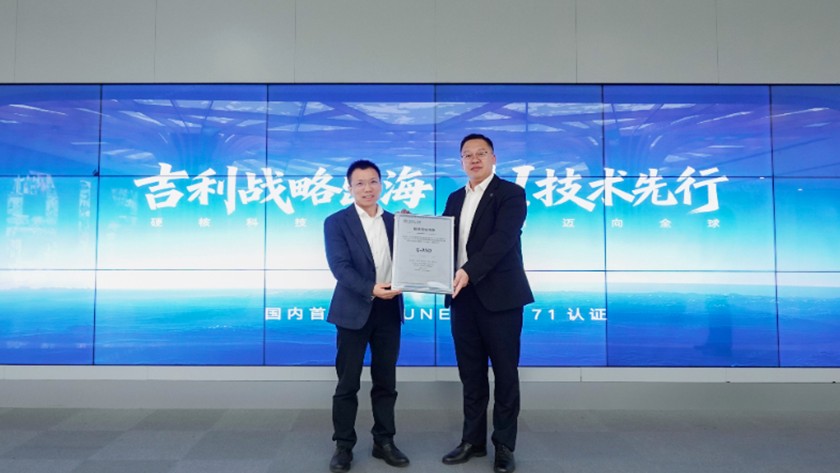
Geely Auto Group has become the first Chinese automaker to receive European regulatory certification for its advanced driver assistance system (ADAS), marking a significant step forward for the country’s automotive technology on the international stage. The “G-ASD” system, developed by Geely subsidiary Afari Technology, was granted UN R171 certification on March 13th, clearing the path for deployment in European vehicles by June 2026.
What This Means for Geely and China
This certification is crucial because it streamlines market access. UN R171 approval acts as a “passport” allowing vehicles with the certified system to be legally sold across all member states of the United Nations Economic Commission for Europe without individual country approvals. Previously, only BMW had achieved this milestone, in late 2025, making Geely’s success a notable first for a Chinese manufacturer.
The initial rollout will focus on Lotus vehicles in Europe this June; Lotus is a British brand now owned by Lotus Technology, itself a Geely Holding Group subsidiary. The certification is not just about Geely’s success, but about China’s ambition to compete in the global automotive tech race.
European Regulations and Market Dynamics
Geely’s CTO, Li Chuanhai, notes that current European regulations limit the system’s functionality to highway assistance. More advanced urban navigation features, common in China, have yet to be approved due to stricter safety standards. However, Li emphasizes that European authorities are not inherently opposed to innovation, pointing to Mercedes-Benz as the first automaker worldwide to achieve Level 3 autonomous driving certification in Europe.
The European market is evolving rapidly, and consumer demand for intelligent driving features is growing. McKinsey research suggests that fully autonomous vehicles could account for 25% of European auto sales by 2035. This presents a substantial opportunity for Geely and other Chinese firms.
Global Expansion and Challenges
Other Chinese automakers, including XPeng and Nio, are already equipping export models with basic driver assistance systems. Suppliers like iMotion and Zhuoyu Technology are establishing overseas operations to support this expansion, building local R&D and service infrastructure.
However, significant hurdles remain. Intelligent vehicles require continuous lifecycle services, including data collection and cross-border transmission, raising data security and regulatory concerns.
Geopolitical tensions are also a factor. The U.S. government has announced plans to phase out Chinese-made connected vehicles from its market starting in 2027, and other nations are tightening import-export controls on intelligent connected vehicle technology.
Looking Ahead
Despite these challenges, Geely remains optimistic, asserting that Chinese companies are leading in driver assistance technologies. The company plans to integrate the G-ASD system into its Geely, Zeekr, and Lynk & Co vehicles for overseas markets. This move is part of a broader trend: Chinese automotive tech is no longer confined to domestic markets, and international expansion is now an inevitability.
The certification marks a crucial step for Geely and China, signaling a shift in the global automotive landscape. The race to dominate intelligent vehicle technology is heating up, and Chinese firms are determined to play a leading role.