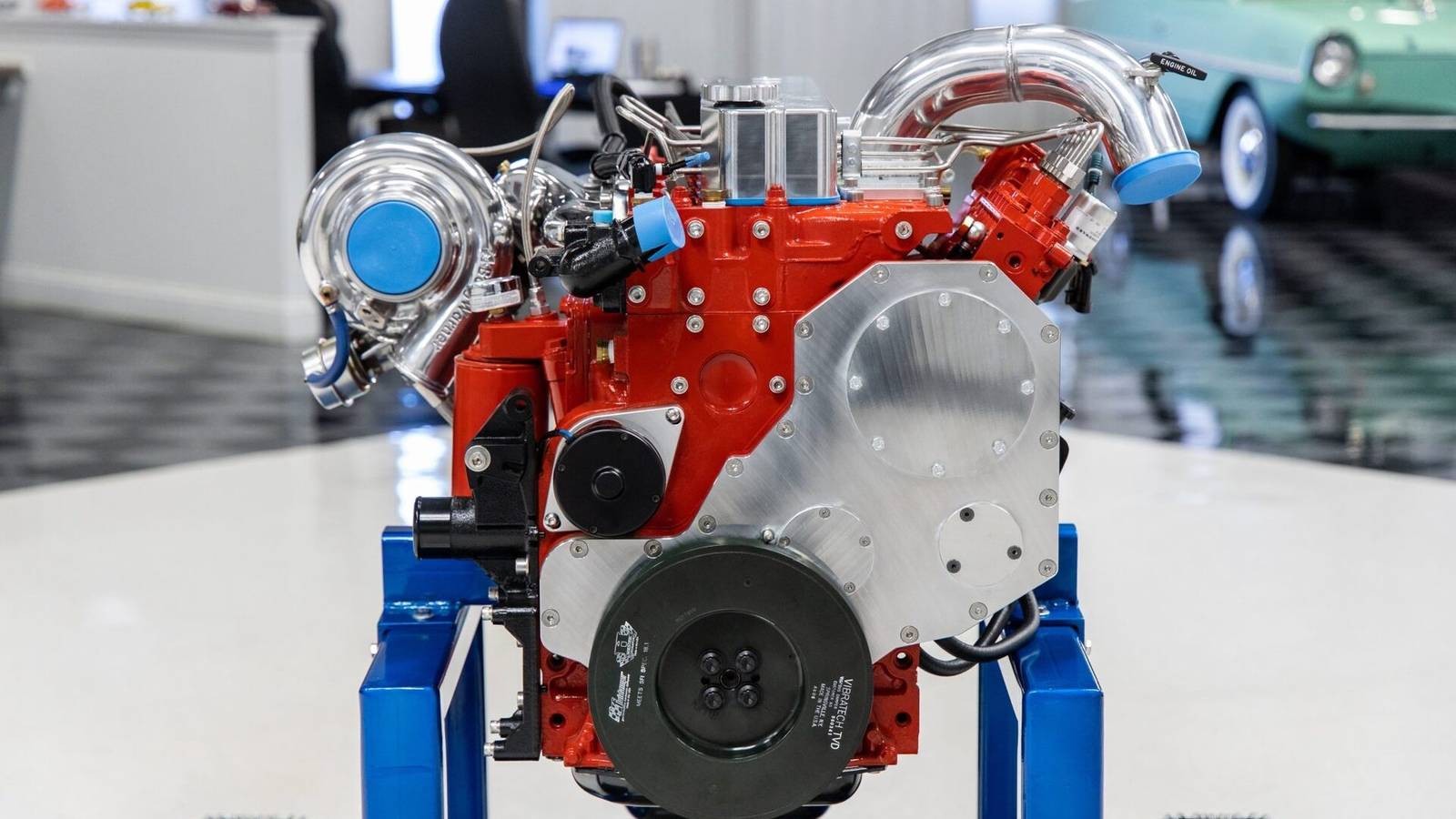
The automotive world celebrates iconic cars, but sometimes, greatness lies not in the vehicle itself, but in what powers it. The Cummins 5.9-liter diesel, or “6BT” as enthusiasts call it, isn’t just an engine—it’s a legend. Originally designed for industrial reliability, it reshaped the pickup truck market and earned a devoted following for its simplicity, durability, and performance. Even today, it remains the gold standard for diesel power. This is the story of how one engine became the most respected in truck history.
The Rise of a Workhorse
In 1984, Cummins introduced the 5.9-liter turbo-diesel for commercial use. But its true impact came in 1989 when Dodge integrated it into the RAM pickup, creating an unlikely but enduring partnership. This wasn’t just a new engine; it was a turning point. While others relied on gas, Dodge offered a diesel built to last, attracting both work crews and enthusiasts alike.
The 5.9-liter’s design was brutally simple: a cast-iron block, a forged crank with seven main bearings, and a gear-driven cam. This wasn’t about luxury; it was about survival. Unlike competitors’ V8s, Cummins used direct fuel injection from Bosch, paired with a Holset turbocharger, resulting in a powerful, efficient engine ideal for heavy-duty work.
A Revolution in Reliability
The Cummins 5.9-liter didn’t just perform well; it endured. Its robustness quickly turned it into a benchmark for reliability. While other vehicles struggled to hit 200,000 miles, Cummins engines were routinely exceeding 500,000, even reaching a million without major overhauls. This wasn’t just luck. It was a deliberate design philosophy built around minimal complexity and maximum toughness.
Cummins’ reputation is so strong that the company maintains a dedicated “Million-Mile Club”. Howard Clayton drove his 2000 Dodge RAM 3500 to 2.6 million miles, and Harry and Shirley Albach reached 1,020,000 in their 2001 model. These aren’t outliers; they’re proof of an engine built to outlast the vehicle around it.
Performance Beyond Expectations
The 5.9-liter didn’t just survive; it thrived. The original engine delivered 160 horsepower and 400 pound-feet of torque, but Cummins continued to refine it. By its final iteration, it produced 325 horsepower and 610 pound-feet of torque while maintaining good fuel efficiency.
However, the engine’s true potential lay in its tunability. Simple modifications, like a larger turbo and upgraded injectors, can easily unlock 600 horsepower and 1,000 pound-feet of torque. Skilled tuners have even pushed it to 1,500 horsepower and 2,000 pound-feet, making it competitive in off-road, drag racing, and even high-performance applications.
The Evolution of a Legend
The Cummins 5.9-liter didn’t appear overnight. The engine evolved through four distinct generations:
- 12-Valve (6BT): The original, paired with a manual or automatic transmission, offering bulletproof reliability and fuel economy.
- Second Generation (1994): Improved fuel delivery with a Bosch P1700 pump, increasing output to 175 horsepower and 420 pound-feet.
- Third Generation (1998): Introduced a 24-valve design with electronic engine management, boosting power to 235 horsepower and 460 pound-feet.
- Fourth Generation (2003): Common rail fuel injection for smoother operation, better economy, and peak output of 325 horsepower and 610 pound-feet.
From 5.9 to 6.7: The Legacy Continues
In 2007, Cummins replaced the 5.9-liter with the 6.7-liter Turbo Diesel to meet stricter emissions standards and deliver more power. The 6.7 retains the core cast-iron construction but adds advanced fuel and air delivery, now producing up to 420 horsepower and 1,075 pound-feet of torque.
Despite the improvements, many enthusiasts still prefer the original 5.9-liter. It wasn’t just an engine; it was a statement. It set the standard for performance, durability, and longevity in pickup trucks and commercial vehicles. The Cummins 5.9-liter wasn’t just part of those trucks; it defined them.
The Cummins 5.9-liter isn’t just a piece of machinery. It’s a testament to the power of simple, robust engineering. It’s why, decades later, enthusiasts still seek it out, not for what it is, but for what it represents: an unbreakable legacy in the world of diesel engines.