


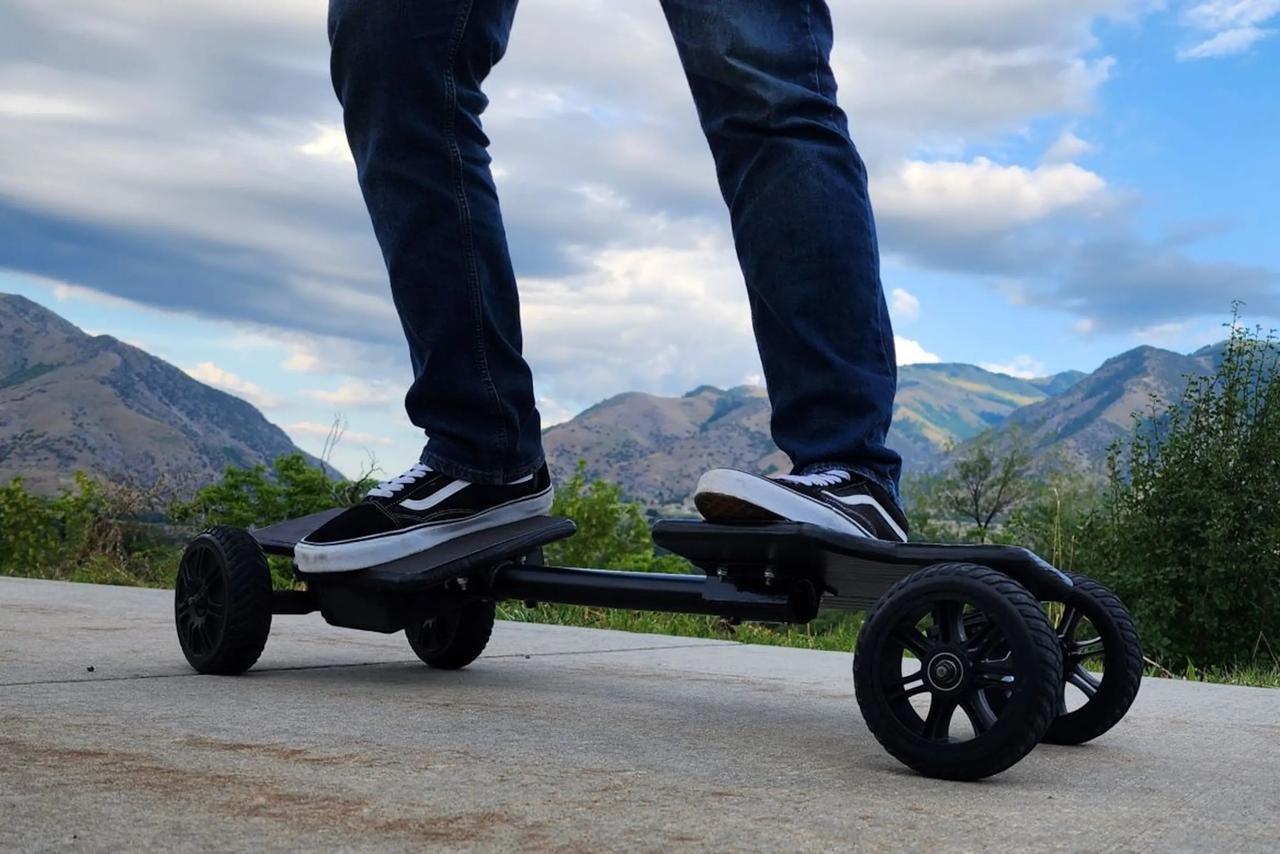
This is a longboard. It’s a RipStik. It carves like a snowboard.
Velocity Etch is an electric skateboard project that doesn’t fit in one box. At first glance, geometry looks like a technical puzzle. Two pairs of huge wheels are placed at the front and rear. The deck? It is divided into two separate plates and hinged to a central tube frame.
Lean forward. Lean back to brake. You twist your hips to turn.
It mimics the oscillating motion of the classic RipStik, but adds stability to the longboard and the aggressive carving characteristics of the board’s motion.
Who created this monster? Why?
The brain behind Velocity Etch is Kevin Ravenberg. He is based in Utah, USA. Like many mechanical hobbyists, he initially approached it as a fun side project. He wanted something fast. Something fun.
To achieve this, he did not use a single motor. He attached two 1500 watt electric motors to the board.
That’s 3,000 watts is 3000 watts.
Control is done with a wireless remote control. Simple. Effective. The result? Top speed reaches 39 km/h (about 24 miles per hour).
Note the speed limit. In most areas, the speed of electric skateboards is limited to 25 km/h. The Etch blows this limit. It’s designed for excitement, not compliance.
Can you really drive it?
Even if you have the specs, there’s no point if you can’t drive it.
The traditional RipStik is notoriously difficult for beginners. The narrow wheelbase and hard plastic wheels do not offer any kind of grip on anything other than polished concrete. One pebble and you’re on the ground.
Ravenberg fixed this.
The Velocity Etch uses four all-terrain pneumatic tires. Air-filled rubber provides traction. It absorbs shocks. You can lean into corners without worrying about slipping.
Here is how it handles real-world conditions:
- Range: 16-24 km on flat terrain.
- Climbing: Suitable for slopes of up to 35%.
- Payload: Rider weight is 80 kg (176 lbs).
- Weight: 11 kg (24 lbs).
- Portability: Divided into three parts. Yes, you can put it in your backpack.
Innovation Costs
Velocity Etch currently has an ongoing crowdfunding experiment. Ravenberg has launched a Kickstarter campaign to fund production.
If the project hits its goal, the Early Bird price is $1,399.
Is it worth it?
that’s steep for a normal electric skateboard. Do you want a dual-motor, 3,000-watt, off-road-shaped beast that can be disassembled and fit into a backpack? Probably not.
This project is ambitious. The physics are sound. However, mass manufacturing such a complex hinge-and-motor system always involves risks.
Ravenberg proved the concept works. Now he needs money to make the real thing.
Will the backers show up?


