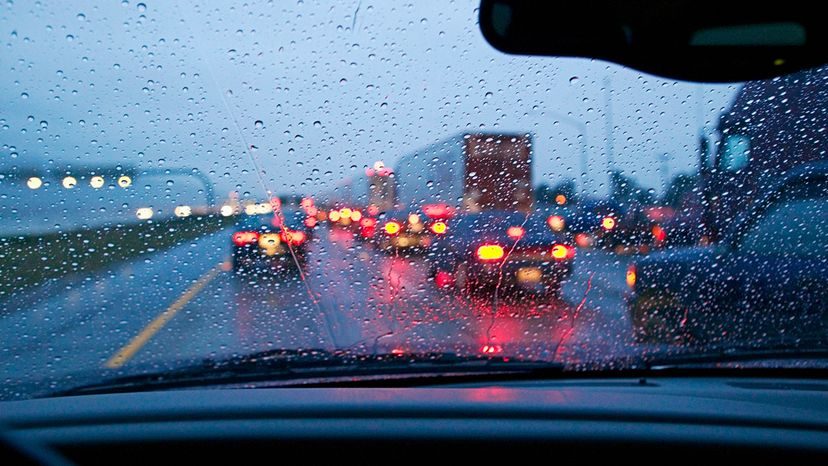
The sky turns black. The windshield wipers are maxed out. Visibility drops to zero. What do you do?
Most drivers have an instinctual reaction: hit the hazard lights. Flashing amber signals feel like a beacon. They scream, “Hey, I’m here, but I’m not moving right.” It feels safe. It feels responsible.
It is probably the wrong move.
Pulling over and waiting for the storm to pass is the safest option, assuming you can find a spot that isn’t a traffic lane. But if you’re stuck on the highway, inching forward in a deluge, turning on your hazards is where things get messy. Not just legally messy. Dangerously so.
The Legal Minefield
Let’s start with the law, because it varies wildly depending on where your tires are rolling.
In many jurisdictions, hazard lights are strictly for stationary vehicles. They are a warning beacon for things that have stopped working or are blocking the road. Using them while moving? That’s a ticket in several places.
Take Georgia, for instance. Police there emphasize that hazards are for when you are stopped on the shoulder. They are not a “drive through the hailstorm” tool. Cross the state line into Louisiana, and the rules flip. There, you are legally permitted to use hazards while driving. Go into neighboring Mississippi, and the legality vanishes again.
It’s a patchwork quilt of regulations. Some states allow flashing lights during funeral processions or at low speeds. Others ban them entirely, with no exceptions for bad weather. If you are driving across state lines or international borders, checking the local statutes is not just bureaucratic busywork. It is a way to avoid a fine.
The Signal That Says Nothing
Legality is one thing. Safety is another. And this is where using hazards while driving becomes genuinely risky.
Think about what your taillights tell the driver behind you. A steady red light means “I am here.” A brighter red means “I am braking.” Off means “I am maintaining speed or accelerating.”
Hazard lights destroy that communication.
When you flash both front and rear turn signals simultaneously, you create a strobe effect that confuses the brain of the driver following you. They cannot tell if you are slowing down. They cannot tell if you are about to change lanes. The signal is binary: flashing. That’s it.
Hazard lights are designed to send a “look at me!” message to other drivers. Using them while driving sends mixed signals.
If you are crawling along at 20 mph in a rainstorm with hazards on, the driver behind you might assume you are stopped on the side of the road. They might drift left to pass. Or they might slam on their brakes, thinking you’ve already stopped. Both scenarios end with crumpled metal.
It is a distraction. It diverts attention from the road to the lights. It makes your brake lights harder to distinguish. In low-visibility conditions, clarity is everything. Hazards provide none.
What Actually Works
So, if you aren’t pulling over, how do you survive the downpour?
AAA offers straightforward advice, stripped of the drama.
- Headlights on low beam. Not high beams. High beams reflect off the rain and snow, creating a white wall of glare that blinds you. Low beams cut through the precipitation without bouncing back.
- Drive slowly. In the middle lane. The left lane is for passing. The right lane is for slow traffic and exits. The middle lane offers the most buffer space between you and oncoming traffic on the shoulder or faster lanes.
- Turn off cruise control. This is non-negotiable. In wet conditions, traction is limited. Cruise control tries to maintain a set speed. If you hit a patch of standing water (hydroplaning), the system will keep spinning the wheels or accelerating, making you lose control. You need to modulate throttle and brake pressure manually.
- Smooth inputs. Do not slam the brakes. Do not jerk the steering wheel. Small adjustments. Let the car settle.
The goal is predictability. You want the driver behind you to know exactly what you are doing. Steady lights. Smooth movements.
The Parking Paradox
There is one final rule that often trips people up.
You might think, “I’ll just pull over to the shoulder, turn on my hazards, and wait it out.”
That is the right idea, with one major caveat. Do not double-park.
Parking in a travel lane, even if you are flashing your hazards, is illegal in almost all places. It blocks traffic. It creates a hazard. If you must pull over, find a rest area, an exit, or a wide shoulder that does not impede