


Self-driving cars are everywhere in the news. Tesla’s Autopilot dominates headlines. But we aren’t there yet. We can’t summon a robot taxi to pick us up from the bar. Not really. Not safely.
Researchers at the University of Nottingham in the UK wanted to see what happens when humans meet these ghost cars. They needed to test pedestrian trust. Real-world interaction. Not a simulation.
The setup was inventive. They used a Nissan Leaf electric vehicle. To pedestrians, it looked completely empty. No driver. Just glass and metal. The truth was hidden.
The Fake Driver Setup
The secret was in the driver’s seat. Scientists strapped in a dummy. It wasn’t a crash test dummy. It was a mannequin dressed in car upholstery. It wore a helmet that looked exactly like a headrest.
Pedestrians on the street saw no human. They saw a driverless car. This allowed researchers to measure genuine hesitation. Did people cross? Did they wait? How much did they trust the machine?
The study focused on pedestrian interaction with autonomous vehicles. Can you tell if a car wants to stop? Can you trust it to do so? These are the missing links in autonomous vehicle pedestrian safety.
Visual Communication Systems
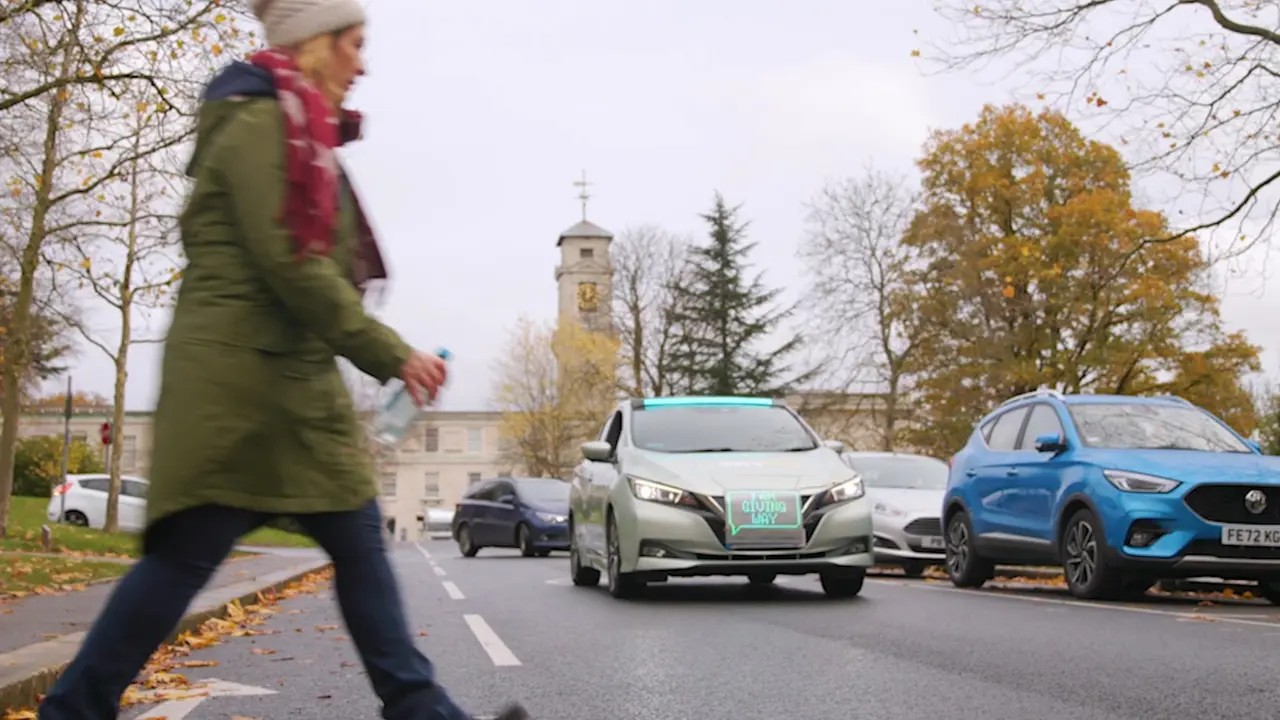
Cars don’t talk. Yet. But the Nottingham team added LED strips to bridge the gap. They tested three different visual display systems. These were external lights aimed at pedestrians.
The goal was simple. Communicate intent. Tell people whether to cross or wait.
One system sat on the grille. Another ran along the top of the windshield. They used colored LED lights. Green likely meant go. Red meant stop. Yellow or amber meant caution. The researchers observed how these signals changed pedestrian behavior.
Without a driver to make eye contact, pedestrians rely on cues. These LEDs were those cues. The study asked: do lights build trust? Or do they confuse people?
The results matter. As we move toward Level 4 autonomy, cars will sometimes drive alone. They will need to signal their presence. Clear communication is key.
Why This Matters
We assume self-driving cars will be safer. Humans make mistakes. Machines don’t. But humans also read intentions instantly. We see a glance. We see a shift in weight. We know someone is watching.
Remove the human. Add a mannequin. Suddenly, the interaction changes.
The Nottingham experiment stripped away the human element to isolate this problem. It’s not just about the car’s code. It’s about the human’s reaction.
How fast does a person trust a light? How much does color affect that decision? These are the questions driving the design of V2P (Vehicle-to-Pedestrian) communication systems.
The data from this study helps engineers build better interfaces. Interfaces that don’t just beep or flash, but communicate clearly.
The road ahead is complex. Not just for the cars. For the people walking beside them.
The Eye Has It: Why Simple Signaling Wins
Forget the complex facial expressions. Forget the scrolling text. The data is in, and for vehicle-to-pedestrian communication, less is more.
The experiment tested three distinct display concepts to gauge how humans react to non-autonomous cues. The first option was stark. A single LED strip formed a large eye. It blinked. That was the signal. The intent was clear: I am braking. You have right of way. Simple. Effective.
The second approach tried to be too clever. It displayed a full face with eyes and scrolling text messages. “I saw you.” “I yield.” It felt like a chatbot trying to make small talk while you’re standing in its path.
The third model used a generic vehicle icon. Again, the goal was to broadcast intent as the car approached a crossing.
Here’s the kicker. None of these systems were actually autonomous. There was no computer parsing the scene. A human operator, hidden in the back seat of the prototype, manually triggered the displays via an Arduino Mega microcontroller. We are talking about a person pressing a button to make a light blink.
Yet, the results didn’t care about the lack of AI.
Human Reaction vs. Tech Limitations
Over the course of the study, dashboard cameras recorded interactions with 520 pedestrians. The findings echoed previous research. As early as ten years ago, studies suggested that an expressive eye is the superior method for communicating vehicle intent. This latest trial confirmed it.
Why does the eye work? It taps into primal recognition. An eye signals attention. It signals awareness. Text requires cognitive load. You have to read it. An icon requires interpretation. An eye just looks. It’s immediate.
But the most telling moment wasn’t about the eye. It was about human habit.
Even though the cars had no drivers, pedestrians kept waving. They raised a hand in thanks. They nodded. They acknowledged the vehicle as if a person were sitting in the driver’s seat.
It’s a glitch in the matrix of social interaction. We are hardwired to expect a human on the other side of the wheel. We don’t just see a machine. We see an agent.
The technology in the back seat didn’t matter. The Arduino wasn’t saving lives. The humans in the back were just triggering lights. But the pedestrians? They were having a real conversation.
So, if you’re building the next generation of autonomous signaling, skip the faces. Skip the text. Build a better eye. And accept that until the cars actually drive themselves, people will keep treating them like neighbors.
The gap between what the tech does and what people expect is wide. And right now, that gap is filled with waves and smiles.


