


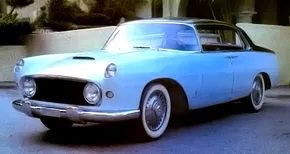
Pinin Farina didn’t just tweak a grille or shorten a hood in the mid-1950s. He dismantled the fundamental logic of Italian carrozzeria design. By the time he unveiled the 1955 Lancia Florida at the Turin Salone dell’Automobile in the spring of that year, the automotive world was braced for another variation on a theme. Instead, they got something that looked like it had been pulled from a different century.
The car arrived as a shock. It was a dramatic show car that signaled the end of an era. For decades, designers had treated bodies as monolithic sculptures—hewn from a virtual block of clay, smooth, heavy, and unified. Farina threw that approach out the window. He replaced the solid lump with a construction based on the symmetrical juxtaposition of curved panels.
Think of it less like a statue and more like a house of cards. Each panel was preformed to a specific aesthetic concept. The starting point wasn’t a solid object; it was a surface. This shift from mass to surface is why the Lancia Florida design matters so much today, even if its significance has faded into the mist of half a century.
Breaking the Monolith
There was no copying here. Farina didn’t lift ideas from his rivals in Turin, London, Milan, or Detroit. He didn’t look to America for cues on how to chop and channel sheet metal. The Florida was a clean slate.
The major theme was form, stripped of decoration. Horizontal emphasis became the law of the land. A strong beltline ran from the front fenders, stretching all the way into the high rear fenders. It blended seamlessly with the backward sweep of the C-post, creating a sense of motion even when the car was parked.
“With the Florida, Farina bid farewell to ‘monolithic’ shapes and said hello to a new principle: body development by symmetrical juxtaposition of curved panels.”
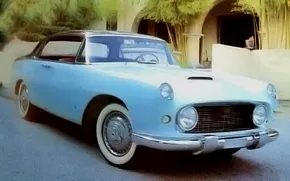
This horizontal motif was reinforced by a full-length sheet-metal crease running just above the wheel cutouts. It wasn’t just decoration; it was structural logic made visible. The car was a hardtop coupe built in steel, featuring a wraparound windshield and “dogleg” A-posts. Those posts were a nod to the contemporary U.S. styling fad originated by General Motors, but they were integrated with a precision that felt distinctly European.
The grille was a flattened oval, a signature Farina shape he would use repeatedly on Ferraris. Headlamps were housed within the grille frame, while smaller auxiliary lamps were recessed into the tips of the front fenders. It was tidy. It was precise. It was nothing like the bulky, chrome-laden appliances rolling off American assembly lines.
Proportions and Presence
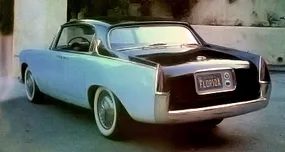
In terms of proportions, the Lancia Florida was perfect for its time. The profile was long and sleek. The rear deck was substantial enough to provide visual balance with the hood, emphasizing the car’s static 50/50 unladen weight distribution. That balance isn’t just a spec sheet detail; it’s a visual anchor.
To modern eyes, the shallow greenhouse and big wheels might look dated. But in 1955, those wheels were a calculated choice. Shod with Michelin X 165-400 tires, they seemed smaller than expected for a car with a 104.3-inch wheelbase. The absence of fixed B-posts counteracted the low roof, giving the interior a definite airiness that closed designs often lacked.
The prototype was finished in two-tone paint: white on the roof and decklid, dark blue everywhere else. It highlighted the separation of surfaces, reinforcing the new design language.
So how did Farina achieve this? How did a single study car trigger a global shift in automotive architecture? The answer lies in the technical execution of those curved panels. The Florida wasn’t just a pretty face; it was a proof of concept for a new way to build bodies. By treating the car as an assembly of distinct, curved surfaces rather than a single molded mass, Farina opened the door to the fluid, dynamic shapes that would dominate the next two decades of design.
The influence is still visible today. Look at the way modern cars manage light and shadow across their flanks. It’s a direct descendant of that house-of-cards approach. The Florida proved that you could have elegance without ornamentation, and speed without bulk. It changed the rules. And the industry never quite went back to playing by the old ones.

The Pinin Farina Connection
The 1955 Lancia Florida wasn’t just another concept car. It was a Pinin Farina original, drawn up by the master himself. But this wasn’t the sprawling operation it would become. At the time, Pinin Farina employed 340 people total, churning out roughly 2,500 bodies a year. For the Florida, he pulled a skeleton crew. No more than 10 draftsmen and modelers. A small, tight-knit team working on a design that would change things.
Francesco Martinengo was likely the key figure in that group. He directed Design, Research, and Quality Control. He’d joined Pinin Farina in 1952. Just before that, he left Stabilimenti Farina, which shut down shortly after he departed. He’d been there since finishing school in 1934. He knew the trade. He knew Lancia.
A Natural Fit
Why Lancia? The chassis was already in the pipeline. Pinin Farina was building bodies for the Aurelia B-20 GT coupe and the B-24 spider. They knew the metal. They knew the tolerances.
But the standard Aurelia sedan? Dated. Introduced in 1950, it felt old by 1955. Some called it odd. It lacked the punch of the new sports variants. The Florida was Lancia’s chance to fix that. It wasn’t just a show car. It was a proposal. A new model. And the timing was perfect.
Enter Antonio Fessia
April 2, 1955. Lancia brought in a new technical director. Antonio Fessia. He was 54. He wanted changes. Immediate ones. His resume was heavy.
He’d been in aeronautics and automotive since 1925. Both sectors at Fiat. In 1946, he designed a front-wheel-drive family car for Caproni. That design? It became the blueprint for the 1960 Lancia Flavia. He’d also worked on Ducati motorcycle engines. Consulted for Pirelli. Fiat brought him back to run engineering in Heilbronn, Germany. He knew how to build cars that worked.
The Decision
Fessia liked the Florida.
Gianni Lancia liked it too.
Gianni was the founder’s son. He ran the business then. He’d run it into the ground later with careless spending. But in 1955? He saw value. He saw the future.
Lancia wanted the Florida. But there was a catch. It needed four doors. The two-door coupe was fine for showrooms. But for volume? For families? Four doors were non-negotiable.
So Fessia went to work. He designed a new chassis. One that could support the Florida’s lines while accommodating the extra doors. This chassis would become the production Flaminia. The Florida was the dream. The Flaminia would be the reality. And it would carry Pinin Farina’s signature into the 1960s.

Pinin Farina’s original Florida coupe sat on the standard Aurelia chassis. That was fine for the high-volume models, which used unit construction. But Lancia had a different approach for low-volume applications. They offered a separate Aurelia GT platform. It was built for custom bodywork. And it was outstanding in many ways.
The heart of that platform was a high-performance V-6 engine. Francesco de Virgilio designed it. He joined Lancia in 1939. Later, he became one of Vittorio Jano’s closest collaborators. Jano was the chief engineer from 1937 to 1955. He was a brilliant innovator. He rivaled Vincenzo Lancia himself in ingenuity.
The suspension setup was equally specific. Front suspension used Lancia’s patented sliding-pillar system. It featured enclosed coil springs. Integral hydraulic shock absorbers were built right in. The rear used a de Dion axle. Semi-elliptic leaf springs supported it there.
The coupe was great. But a four-door version was still needed.
1955 Lancia Florida Four-Door
The demand for a practical sedan didn’t disappear just because the coupe looked good. Pinin Farina had to adapt the Florida’s lines to fit four doors. This wasn’t just an add-on. It was a rethinking of the Aurelia GT’s proportions.
The chassis remained the key differentiator. While mass-market cars relied on unibody design, the Aurelia GT’s separate frame allowed for more flexibility. It could handle the stress of a longer wheelbase. It could handle the extra weight of rear seating and doors.
De Virgilio’s V-6 engine stayed put. It remained the primary reason enthusiasts looked at the platform. The sliding-pillar front suspension was retained. It provided a unique ride quality that coil springs alone couldn’t match. The de Dion rear axle offered improved stability during cornering.
The Florida four-door kept the same basic dimensions as the coupe. But the roofline had to drop. The B-pillar had to move. The rear door hinges had to be placed so they didn’t interfere with the trunk. It was a tight fit.
Lancia understood the market. They knew that a stylish coupe wasn’t enough. Families needed space. They needed access. The Florida sedan provided that access. It kept the performance edge of the GT platform. It kept the elegance of Pinin Farina’s styling.
The result was a car that appealed to a different buyer. Not just the driver who wanted speed. But the driver who wanted to take passengers in style. The chassis handled the extra complexity well. The engine provided enough power to move the heavier body.
It was a logical step. The coupe had proven the design. The sedan proved the utility. Lancia had covered both bases.
The Florida four-door didn’t change the fundamental engineering. It just extended the application. The sliding-pillar suspension still worked. The V-6 still sang. The de Dion axle still held the line.
But the shape was different. The silhouette was lower. The presence was more substantial. It was still a Lancia. It was still an Aurelia. But it was something new.
The market responded. Not everyone wanted a coupe. Not everyone could justify a two

The Four-Door Solution to Pinin Farina Design
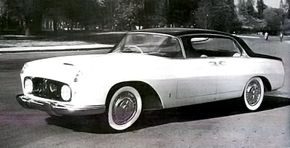
It took Pinin Farina barely a month to sketch out the four-door variant of the 1955 Lancia Florida. By September, the prototype was ready. It sat on the same short-wheelbase chassis as the original coupe, but the geometry shifted to accommodate more doors.
The windshield base moved forward. The hood shortened in response. This wasn’t just cosmetic; it created the physical space needed for rear entry. The styling cues evolved quickly, too.
Headlamps left the grille. They migrated to the front fenders. Parking lights dropped directly beneath them. A distinct air scoop appeared on the hood, borrowing a page from Ferrari’s design manual. The A-posts went vertical, straightening out the profile while keeping that signature wrapped windshield look.
How Pinin Farina Engineered the Pillarless Door System
The four-door Florida remained pillarless. No B-posts meant no center structural supports. Pinin Farina had to get creative to keep the doors secure.
The solution was a center-opening layout. The rear doors didn’t open outward on their own hinges in the traditional sense. Instead, when closed, the rear doors locked into the front doors. All four doors latched onto the sills. This arrangement compensated for the lack of a center post.
“When closed, the back doors locked into the fronts, and all doors also latched on the sills.”
It was a mechanical puzzle. No B-post meant the cabin lacked a vertical support in the middle. Farina’s engineering tied the doors together. The rear doors relied on the front doors for stability. The front doors anchored into the sills. The whole assembly held firm.
The result was a sedan that looked like a coupe. It moved like a coupe. It functioned like a sedan. Pinin Farina squeezed four doors onto a short platform without losing the Florida’s sleek silhouette. The trade-off was complexity. But the aesthetic payoff was immediate.
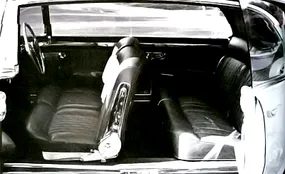

Frameless windows changed the physics of the roof. Without pillars to anchor the doors, Lancia couldn’t mount hinges at the top of the door frame. The company hesitated. They worried about structural integrity. The result was the Flaminia sedan, a return to tradition with full window frames and conventional front-hinged rear doors.
Under the skin, it was a cost-conscious engineer’s dream. The wheelbase stretched to 113 inches. Power came from the biggest Aurelia engine available—a 2.5-liter (152 cubic inch) V-6. It was detuned to 102 horsepower. Probably to keep the car manageable. It used the same front-drive transaxle as the Aurelia. This saved money on tooling.
Suspension told a different story. The de Dion rear setup stayed. But the front end was a radical departure. Giovanni Michelotti’s successor, Carlo Fessia, designed a new front suspension. Upper and lower A-arms. Coil springs. They were angled 20 degrees from vertical. Unconventional. Aggressive.
The Pinin Farina Blueprint
The styling shift in the original Lancia Florida wasn’t lost on competitors. Major manufacturers saw the potential. They approached Pinin Farina. He didn’t just copy the design. He scaled it down.
The new package accepted engines ranging from 1.5 to 2.0 liters (91-121 cubic inches). It was a modular solution for a growing market.
The rollout was rapid. British Motor Corporation adopted it in 1958. They didn’t just pick one model. They applied it across their lineup. The Wolseley 15/60, the Austin A-55 Cambridge, the MG Magnette Mark III, the Morris Oxford Series IV, and the Riley 4/68 all wore the same suit.
Fiat followed in 1959 with the 1800 and 2100. Peugeot arrived in 1960 with the 404.
Styling Differences Across Markets
Grille design varied by region. French and Italian cars favored big, horizontal slats. It looked wide. Low.
British cars were more restrained. Austin and Morris used less daring grilles. Riley and Wolseley stuck to narrow, traditional vertical bars. It felt more conservative.
The rear fenders showed the most divergence. British cars featured pronounced fins. Chrome moldings ran horizontally from the headlight center. They curved downward along the rear door. A distinct silhouette.
The Peugeot 404 took a modest approach with small blades. The Fiats? Straight flanks. No fuss.
Design Evolution
The Florida proved its worth. It influenced a generation of executive cars. But Pinin Farina wasn’t done. He had bigger plans for the design language.
The story continues on the next page.

Scaling Up: Pininfarina’s Industrial Ambition
The Florida prototype was a commercial triumph on paper. Selling the design rights to various automakers had generated a comfortable income for Pinin Farina, enough to suggest that the firm’s work on the car was done. But Giovanni Farina wasn’t interested in resting on his laurels. By 1955, his company was in the midst of a rapid expansion, aggressively hunting for manufacturing contracts to feed a growing machine.
The goal was simple. Build cars.
To make that happen, Pininfarina purchased a large tract of land in Grugliasco, a suburb of Turin. The new production center broke ground quickly, and by the end of 1958, the facility was already humming with activity. That kind of infrastructure demands constant utilization.
Assembling the Alfa Romeo Giulietta Spider was a logical first step. It was a volume play. The car would eventually see 27,000 units roll off the line. But for a company with grander visions, a Spider assembly line was just a foot in the door, not the whole house.
The Florida II: Back to Basics
Farina needed more volume. More margins. So, in 1957, he went back to Lancia with a new proposal: the Florida II.
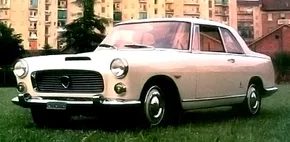
This wasn’t a fresh sketch from a blank page. It was a calculated return to the original Florida concept, but this time, grounded in reality. The Florida II was a two-door coupe built on a shortened wheelbase version of the Flaminia platform.
The key difference? This time, they started with a production model.
Lancia approved the design, though they insisted on tweaking the aesthetic to fit their brand identity. The sharp, raked windshield of the prototype was made steeper. Door glass received frames. Vent windows were added to the doors. A larger air scoop was integrated into the hood to feed the hungry engine.
These weren’t minor adjustments. They defined the final product.
Enter the Flaminia Coupe
By 1958, the Florida II had shed its concept-car skin and entered production as the Lancia Flaminia coupe. It was a direct result of Pininfarina’s pressure to monetize its design capabilities and Lancia’s need for a stylish, performance-oriented body to sit atop its mechanicals.
The numbers told the story of that partnership.
Built on a 108.3-inch wheelbase, the coupe shed weight compared to its sedan sibling, tipping the scales at 3,175 pounds. But the real gain came from the heart. Lancia uprated the engine output to 119 horsepower.
The result was immediate. Top speed jumped from the sedan’s 99 mph to 111 mph.
It was a modest increase in raw velocity, but significant in the context of a car that was supposed to be elegant rather than aggressive. The Flaminia coupe proved that Pininfarina could take a platform and transform it into something with distinct character.
“The Florida II marked a return to the original concept, but with the advantage of a production baseline.”
The facility in Grugliasco was now producing high-value coupes alongside the volume-selling spiders. The expansion wasn’t just about having space; it was about having leverage. Pininfarina had
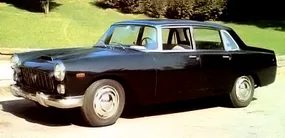

Pinin Farina turned out 5,235 Flaminia coupes in nine years. They made it to the US. The Florida II prototype lived out its days as the maestro’s daily driver. The sedan ended production in 1963. Nearly 3,300 rolled off the line. That total included 600 late-run models. These wore a 2.8-liter V-6. The engine pushed 125 horsepower.
Pinin Farina died in 1968. Lancia joined the Fiat conglomerate in 1969. Ten years prior, it had been part of the Italcementi group. The bond between Lancia and Pininfarina (renamed in the early 60s) loosened. It didn’t break. The collaboration survives to this day.
The Florida line returned strongly. It appeared in the 1971 Fiat 130 coupe. Pininfarina designed it. You can spot its DNA in the 1980s Peugeot 505. The design language rippled outward. Countless engineers adopted it. It shows up in Jaguars. Rolls-Royce and Bentley models carry its ghosts. So do BMWs. Ford. Nissan. Volvo.
It was a milestone in car design. The Florida stands as one of Pinin Farina’s greatest single efforts. Considering his other masterworks, that’s a high bar.
For more on the metal, check out guides on classic cars, muscle cars, sports cars, and new or used car searches.


