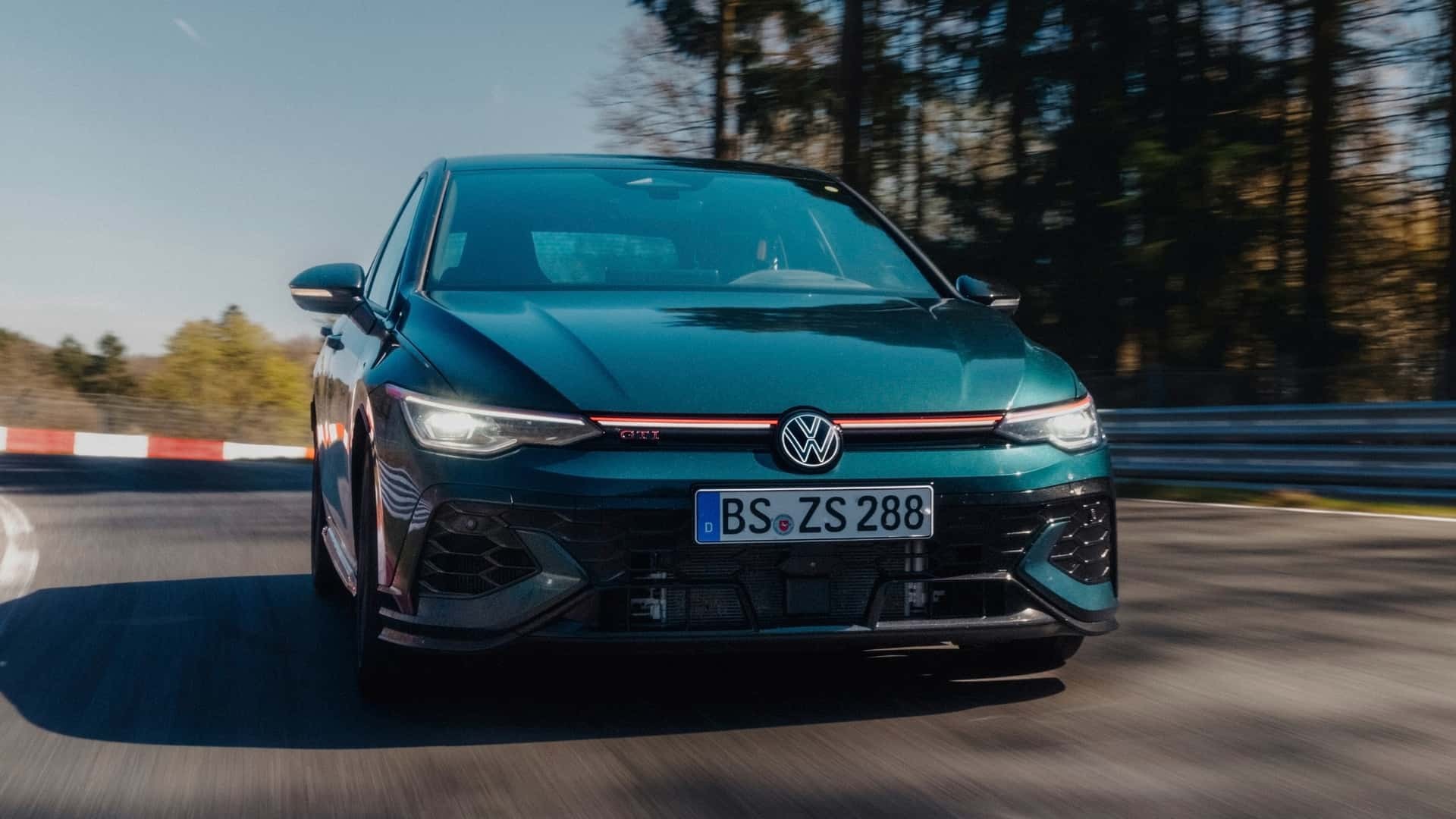
The Volkswagen Golf GTI Edition 50 has officially dethroned the Honda Civic Type R as the fastest front-wheel-drive production car at the Nürburgring Nordschleife. This milestone cements the hot hatch’s legacy at the “Green Hell,” a track that has long served as the ultimate proving ground for performance vehicles.
A Narrow but Historic Victory
The battle for the title was fierce and ultimately decided by a margin of less than half a second. Development driver Benjamin Leuchter piloted the 320-horsepower GTI to a lap time of 7:44.52. This effort edged out the Honda Civic Type R’s previous record of 7:44.88, which was set in 2023.
While the difference is marginal, it carries significant weight in automotive history. Both times were recorded on the longer 20.832-kilometer configuration of the Nordschleife, ensuring a fair comparison. The previous benchmark holder, the Renault Megane RS Trophy-R, sits third with a time of 7:45.3, though that model has been discontinued for years.
Why this matters: In an era where internal combustion engines are facing regulatory pressure, records at the Nürburgring serve as a final testament to mechanical engineering prowess. The GTI’s victory is not just about speed; it is a symbolic win for traditional hot hatches against a shrinking field of competitors.
The Cost of Performance
The Golf GTI Edition 50 is not only the fastest; it is also one of the most expensive variants in the Golf lineup. In its home market of Germany, the starting price was €54,540 (approximately $64,220 USD, excluding VAT). This places it above the standard GTI (€46,250) and the track-focused GTI Clubsport (€49,820).
For context, the all-wheel-drive Volkswagen Golf R remains the most expensive option at €55,540 for the hatchback and €56,810 for the wagon. Notably, the Edition 50, like all modern GTIs and Rs, comes exclusively with an automatic transmission. The return of a manual gearbox to these performance models appears unlikely, as Volkswagen shifts focus toward automated efficiency and broader accessibility.
The Future of the Hot Hatch
Despite the rapid transition to electric vehicles, Volkswagen has committed to keeping the combustion-engine Golf GTI in production well into the 2030s. This decision provides a rare sense of stability for enthusiasts who fear the immediate extinction of gasoline-powered performance cars.
However, the brand is also looking ahead. The ID. Polo GTI, an electric hot hatch, is scheduled to debut later this year. This marks the first time the prestigious GTI badge will be applied to an electric vehicle, signaling a transitional phase where heritage meets new technology.
Competitive Landscape
With the Honda Civic Type R discontinued in Europe due to stricter emissions regulations, the GTI’s record is currently secure. The “Final Edition” CTR marked the end of an era for Honda’s European presence, leaving a vacuum at the top of the FWD leaderboard.
While Honda continues to sell the Civic Type R in regions with more relaxed legislation, the threat of a special edition reclaiming the title remains low. Other potential challengers, such as the Mini John Cooper Works GP, would need to improve their lap times by more than 12 seconds to compete—a daunting task given the GTI’s current dominance.
Conclusion
The Volkswagen Golf GTI Edition 50’s record-breaking lap is a significant achievement that highlights the enduring appeal of front-wheel-drive performance cars. As the industry pivots toward electrification, this victory serves as both a celebration of past engineering and a bridge to the future of hot hatches.