


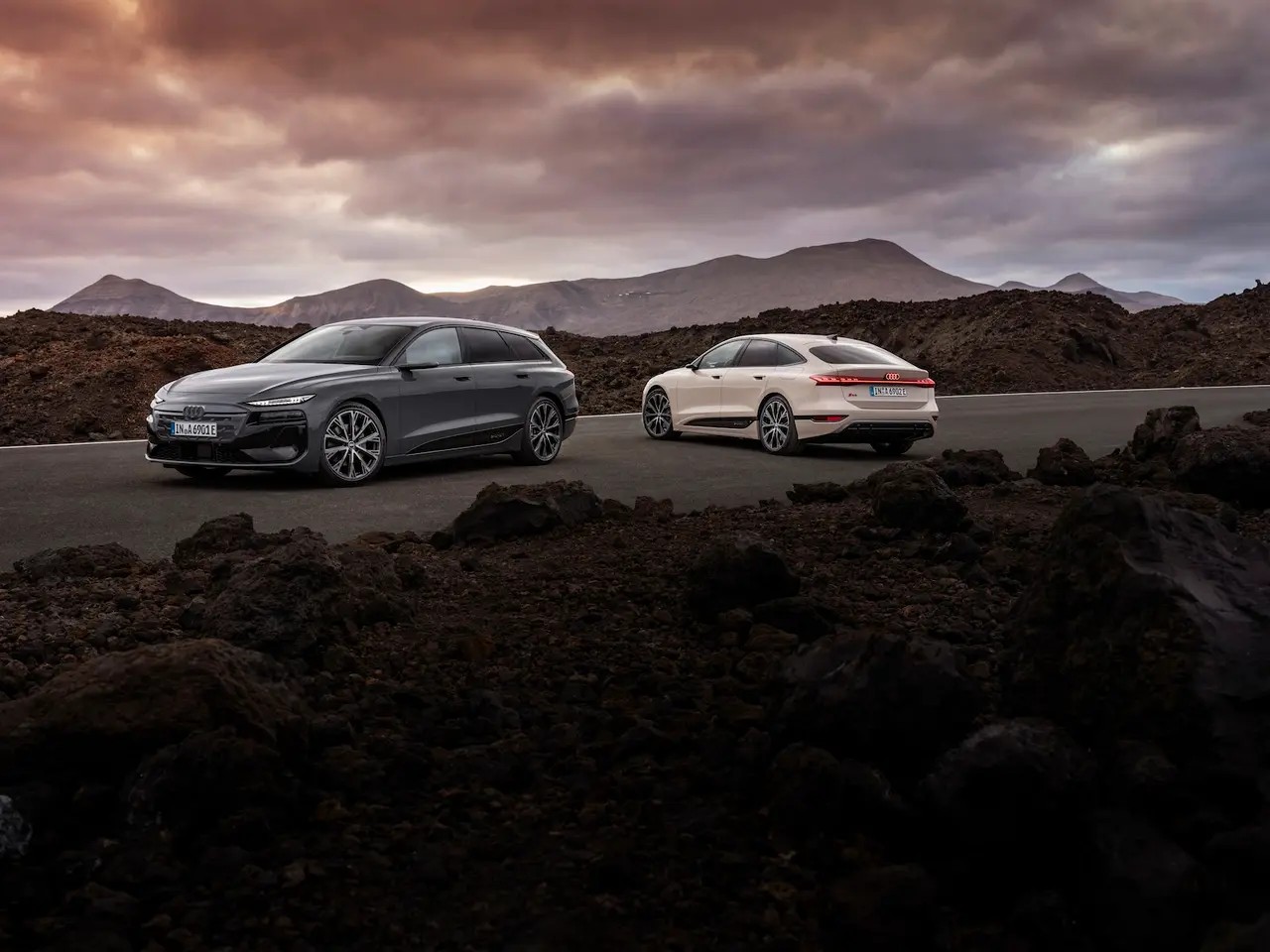
The new Audi A6 e-tron isn’t just another EV. It’s the blueprint for where the entire brand is heading. The next-generation sedan and wagon sit on a 100% electric platform, built specifically for one purpose: going far. Because the A6 line has always been about long-distance comfort, Audi engineered these models to maximize range without sacrificing the driving experience you expect from a large German luxury car.
How the 800-volt architecture solves the range equation
You need two things in a mid-size electric sedan. Speed. Distance. Audi understood that. The new A6 e-tron delivers both without compromise. It sits in the same league as the Tesla Model S, which keeps pushing its range figures higher. Ingolstadt had to answer. They did.
Every variant of the A6 e-tron runs on the same powertrain foundation. One battery. Different trims, yes. But the pack stays consistent. 100 kWh in gross capacity. That drops to 94.9 kWh in net usable energy.
The 800-volt architecture is the key. Same as the Porsche Taycan. Fast charging meets long range.
This is not a 400-volt platform trying to keep up. It is built for high-current flow. Charging speeds climb. Downtime shrinks. You can fill the battery quickly without the heat management headaches that plague lower-voltage systems.
Why does voltage matter here? Because power equals current times voltage. To move a lot of energy fast, you need either huge current (thick cables, heavy connectors, heat issues) or higher voltage. Audi chose the latter. The result is a car that recharges efficiently while still holding enough energy for a 757 km range.
Which rivals actually threaten the A6 e-tron?
The Tesla Model S is the obvious comparison. It has been the benchmark for executive electric sedans for years. But the A6 e-tron is not just another EV. It is a direct challenge to Tesla’s dominance in the premium sedan segment.
The 757 km figure is not a lab number. It is a practical claim. It puts the A6 etronn in contention with the longest-range EVs on the market. Drivers who previously chose the Model S for distance capability now have a German alternative that matches it.
- Battery capacity: 100 kWh gross / 94.9 kWh net
- Architecture: 800 volts
- Claimed range: 757 km
- Direct competitor: Tesla Model S
- Sister technology: Porsche Taycan
The platform sharing with the Taycan is significant. Porsche’s EV flagship proved that 800-volt systems work in production. Audi is leveraging that proven infrastructure for a wider audience. The A6 e-tron gets the same charging efficiency as a $200,000 Porsche, but at a sedan price point.
Does that make it the better car? Not automatically. But it removes the range anxiety objection. You can buy a German luxury electric sedan and not worry about finding a charger every 300 kilometers. The hardware supports long-distance driving. The battery supports it. The architecture supports it.
The question now is whether Audi’s execution matches the hardware. The specs are there. The range is there. The charging speed potential is there. What remains to be seen is how the driving dynamics and interior quality hold up against the Model S in daily use. But on paper, the A6 e-tron checks every box that matters for a long-distance electric executive car.
310 km de charge en 10 minutes : la mécanique derrière la performance
Le système de refroidissement décrit précédemment n’est pas la seule astuce technique. L’Audi A6 e-tron utilise une division électronique du pack de batterie. Le système scinde le bloc en deux circuits distincts de 400 volts. Pourquoi faire ça ? Pour recharger les cellules en parallèle.
Le résultat est concret. Sur une borne de recharge compatible, le véhicule récupère jusqu’à 310 km d’autonomie en dix minutes. C’est un chiffre qui change la donne pour les trajets longs. Vous n’avez pas besoin d’attendre que la batterie passe de 20 % à 80 % pour reprendre la route.
Autonomie et performance : les chiffres précis de l’A6 e-tron et S6
Les données WLTP sont claires. La version Sportback affiche 757 km d’autonomie en cycle mixte. La variante Avant, en break, s’établit à 721 km. L’écart s’explique par la traînée aérodynamique, mais aussi par la configuration moteur.
La version propulsion standard délivre 367 ch. Suffisant pour un 0-100 km/h en 5,4 secondes. Pas mal, mais ce n’est pas le sommet de la gamme.
La S6 e-tron pousse la puissance à 503 ch. Avec l’overboost, le chiffre grimpe à 550 ch. Le 0-100 km/h tombe à 3,9 secondes. L’autonomie recule légèrement sous l’effet de cette exigence : 676 km pour la berline et 648 km pour le break.
Cx de 0,21 : comment le profil de la carrosserie influence l’autonomie
La batterie est grosse, oui. Mais l’A6 e-tron ne repose pas uniquement sur sa capacité. La forme compte. Le coefficient de traînée (Cx) est de 0,21 pour la Sportback. C’est très bas.
Le break Avant atteint 0,24. Ce simple chiffre explique une partie de l’écart d’autonomie entre les deux carrosseries. L’air frappe le pare-brise et glisse sur le toit. Chaque millième de Cx se traduit en kilomètres gagnés ou perdus.
La nouvelle A6 etronn’a pas juste changé de nom. La sage berline est devenue une Sportback. Le profil est plus bas, plus tendu. L’aérodynamique n’est plus un détail d’ingénierie enfoui dans le manuel. C’est un argument central pour atteindre ces 757 km sans sacrifier la vitesse de recharge.
La question reste ouverte. Est-ce que les 10 minutes sur la borne suffisent pour remplacer l’essence ? Pour beaucoup, la réponse dépend moins de la batterie que de la disponibilité du réseau. Mais avec 310 km en dix minutes, la marge de manœuvre est réelle.
Virtual mirrors and the A6 Sportback’s role in the e-tron lineup
Audi is reshaping its traditional lineup, and the Audi A6 Sportback fits right into the puzzle. The brand dropped the four-door sedan variant from the e-tron family. Instead, the A7 Sportback exits the scene, making way for the A6 with its five-door liftback body style. This shift signals a clear consolidation. The German automaker is simplifying its electric offerings by merging design languages and body types.
Technology plays a huge part in this update. The new Audi A6 e-tron is packed with hardware. Some of it is fresh. Much of it has already appeared on other premium models from the brand. One standout feature stands out: optional virtual exterior mirrors with integrated cameras.
These digital side mirrors replace traditional glass. They help reduce drag. The car achieves a better Cx coefficient because of them. Audi borrowed this specific tech from the Q8 e-tron. It is not a new invention. It is a transfer of proven equipment to a new platform. For enthusiasts, this means less wind noise and potentially better efficiency. The camera feeds display on screens inside the cabin. You see what you would normally see in a mirror, but through a lens.
The virtual mirrors contribute to the vehicle’s excellent aerodynamic coefficient.
This isn’t just a gimmick. It is a functional change. The A6 e-tron benefits from the same engineering principles that made the Q8 e-tron efficient. As Audi continues to remodel its traditional ranges, expect more crossover features between models. The A6 Sportback is the vehicle that absorbs the A7’s role in the electric segment. It is the bridge between the old structure and the new one.
How the Audi A8 OLED rear light cluster works
The rear lighting signature gets a complete overhaul. 10 OLED panels sit in the back, breaking down into 450 segments. This isn’t just a cosmetic tweak. The front and rear optics adopt a three-dimensional design, giving the car a more sculpted look than its predecessor. Inside, the MMI system gets a curved 14.5-inch panoramic display. It stretches across the dashboard, replacing the traditional cluster setup. Why 14.5 inches? It’s wide enough for split-screen navigation and media without distracting the driver.
Which Audi A8 features stand out for tech enthusiasts
The Audi A8 focuses on visual impact and digital immersion. The OLED technology allows for precise, high-contrast illumination. Each of the 450 segments can light up independently. This enables custom light signatures and dynamic turn signals. The 3D optical design extends this effect to the front, making the headlights look deeper and more layered. For drivers who care about cabin ergonomics, the curved panoramic screen integrates the instrument cluster and infotainment into a single, cohesive view. It’s not a dual-screen setup. It’s one wide, curved panel. That matters for usability at high speeds.


