You have to look hard to find something like this.
Most car buyers think of the Ford Motor Company’s Mercury brand as a relic of the early 2000s, or a mid-tier alternative to Ford. It died in 2010. But before it vanished, it carried a legacy of chrome, wood, and presence. Now, that history is showing up on Bring a Trailer, rolling into view with a rare factory-approved 4×4 system bolted to the undercarriage.
This is not just a collector’s static piece. It is a functional machine.
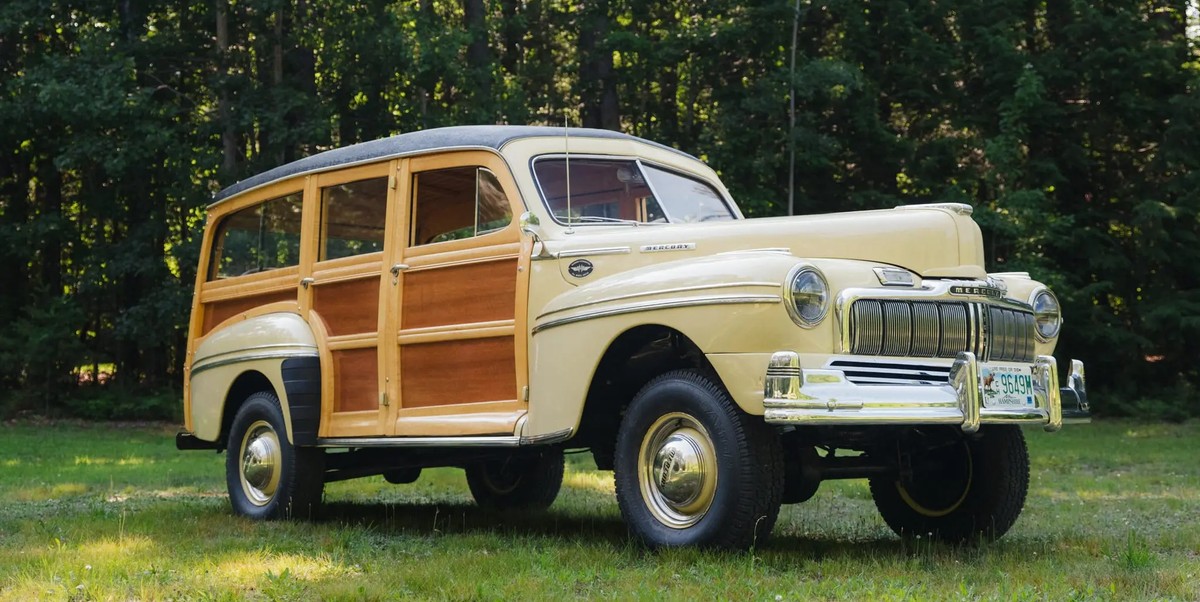
It sits right now as a listing for a 1948 Marmon-Herryton Mercury Woody Wagon. Yes, Marmon-Herrington. That name belongs in any discussion about American 4×4 history. Based in Indianapolis, the firm started making conversions for Willys and Jeepster, and they tapped Ford dealerships to sell these conversions brand new in the 40s. It is almost inconceivable today, but in the late 1940s, if you wanted all-wheel-drive for a civilian sedan, you went to Marmon-Herrington and paid up.
This specific wagon features that Marmon-Herrington drivetrain.
Look at the bodywork. The “woody” aesthetic—massive panels of natural wood framing the glass—was standard luxury at the time. Most cars were steel and painted to look expensive. These used real timber. Hundreds of pieces. This example preserves that craft. The wood construction rivals a Napoleonic sailing ship. It is heavy, yes, but it has soul.
The drivetrain tells another story. Under the hood sits a 255-cubie flathead V8. It produces roughly 100 horsepower. Not enough for modern highways. It makes plenty enough for gravel backroads. That is what these cars were for. The flathead is simple. Reliable, if you maintain it. It pushes air through a 3-speed manual transmission that has been equipped with synchromesh. You can actually drive this down the road without grinding the gears apart every time you slow down for a stop sign.
There are three rows of bench seating. You can pack the family. Or the varsity baseball team. Maybe both, if they fit on the seats. Cargo capacity is ample for luggage or equipment, which makes sense given the vehicle’s rugged underpinnings. It was designed for exploration before exploration was a marketing term for SUVs with leather seats.
Why keep an old woody around?
It does more than look nice in a showroom.
This particular unit has been through refinishing and was stored in multiple private collections. That means it wasn’t sitting in the rain. It wasn’t eating rust, at least not badly. Recent service records indicate a full engine and transmission inspection, brake work, and necessary axle repairs. All the boxes are checked. The car runs and drives. It feels alive.
Is it fast?
No. Anything north of 40 mph gets loud and a bit anxious for such an old machine. That’s not a flaw; that’s a parameter. This Mercury isn’t here for speed records. It’s for cruising. For drawing eyes. For summer expeditions where the destination is less important than the journey down a dusty track.
The interior has a few modern tricks tucked away. Look at the vintage AM radio on the dash. Beneath the period-correct faceplate hides a Bluetooth module. You can plug your phone in while keeping the authentic 1940s aesthetic. There is also a quartz clock under the glass dash bezel, ensuring it actually tells accurate time despite looking like it belongs in a noir film.
Who buys this?
Someone who wants a car that starts conversations. A 1948 wagon with 4×4 is rare even without the Marmon-Herrington box on the side. With it? You are looking at a unicorn. The conversion makes the vehicle significantly more desirable for actual off-road or bad-weather use than the standard rear-drive wagons flooding the market.
Ford moved on. Lincoln exists as the brand’s upscale anchor, and Mercury’s spot in the lineup was awkward, caught between economy Ford and luxury Lincoln. Some say Ford was wrong to kill Mercury.
Cars like this 1948 woody suggest otherwise. Or rather, they suggest Mercury was worth having around during the post-war boom when creativity actually mattered.
The auction on Bring a Trailer ends on July 22. If you want this piece of automotive history, you might need to move faster than a flathead V8 can pull a heavy load of people down a hill. The clock is ticking, even if the wagon prefers to take it slow.