The 1969 Dodge Charger Daytona didn’t just enter NASCAR history; it forced a rewrite of the rulebook. Its creation was a direct response to decades of gridlock, starting when the Automobile Manufacturers Association pulled out of racing in 1957 under pressure from insurance firms and safety advocates. The industry stayed out for years, citing the post-Eisenhower recession and the rise of economy cars as reasons why racing was irrelevant. That stance crumbled around 1962. The auto industry recovered, and manufacturers began funding racing again.
The 426 Hemi and the Road to Daytona
Chrysler moved first. In 1963, they ignored the AMA’s old agreement to target Ford in NASCAR. Engineers revived a concept from the 1950s: the 426-cubic-inch Hemi V-8. Hemi-powered Plymouths and Dodges dominated the 1964 Daytona race, but Ford struck back quickly. They deployed big-bore engines and aggressive factory racing programs, reclaiming the Grand National title.
Dodge tried to fix its speed deficit with the 1966 Charger fastback. It looked like a rocket on paper, but it was actually slower than its shape suggested. A redesign two years later brought a sleeker coupe profile and spoilers for downforce. The 1968 model was aerodynamically better, but it still trailed Ford cars by four mph. In stock car racing, that gap is massive. One mph equals a football field of distance per lap.
Solving the Rear-End Lift Problem
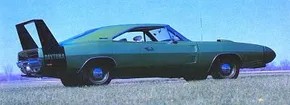
The 1968 Charger suffered from significant rear-end lift at high speeds. Dodge’s engineers didn’t just tweak the trim; they built a solution. They attached a tall, adjustable rear-deck stabilizer composed of twin fins and a horizontal wing to the back of the car. They also sharpened the front nose for better air flow.
The results were immediate. The combination of the pointed snout and the rear wing added five mph to lap speeds. Finally, Dodge had a machine that could genuinely challenge Ford’s and Mercury’s pace. The car was officially designated the Charger Daytona.
Why Only 500 Were Built
NASCAR required a minimum production run for a car to qualify as a “production” vehicle rather than a one-off race project. Dodge planned to build exactly 500 Charger Daytonas. That was the lowest number needed to satisfy the rules. They weren’t building a sedan for the masses; they were building a weapon for the track, just enough to keep it legal.
Why the 1969 Dodge Charger Daytona Was Built to Lose Money
Creative Industries, the Detroit outfit behind countless “specials,” built the 1969 Dodge Charger Daytona. You will see production estimates floating around between 501 and 507. The official factory count settles on 505.
Dealers wanted more. They logged roughly 1,200 orders. Dodge sent hurried telegrams begging them to talk customers out of it. They couldn’t.
The car cost about $300 more than a Charger R/T hardtop. Every unit sold lost between $1,000 and $1,500. Did that matter? No. The mission was winning races, not balancing the books.
Racing versions got the 426 Hemi, a close-ratio four-speed gearbox, and a Hurst shifter. At Talladega, the Daytona set a new official world’s closed-lap speed record close to 200 mph. The victory felt muted. The Fords didn’t show up.
How Tire Wear Ruined the Daytona at Charlotte
The following month, at Charlotte, North Carolina, the Fords arrived. And they beat the Daytonas badly.
Tire wear was the culprit. Chargers had to make brief challenge spurts, then drop back to conserve rubber. Larry Rathgeb, an engineer on the project, said the problem was never really solved.
“Firestone could not, and Goodyear would not, built a tire that could stand up at 200 mph. After five laps you were out of rubber, and that’s not good at all.”
That quote sticks with you. You are pushing 200 mph, and your tires are dusting after five laps. It is not a fixable issue with strategy alone. It is a materials science failure.
Where the Charger Daytona Found Redemption
Salvation came at the Texas 500 in December. Bobby Isaac drove his Daytona to a firm win over the Ford entries. The average speed clocked in at 144.277 mph.
The 1969 season ended strong. The Daytona won 80 percent of its races. It took home 22 Grand National victories. Ford had only four more.
But Dodge’s fling with stock-car racing ended right after that year. Plymouth picked up the corporate torch with the Road Runner Superbird. Similar idea. Quite successful execution. Different era.
1969 Dodge Charger Daytona Specifications
- Engine: 426 cubic inch Hemi (racing spec)
- Transmission: 4-speed manual, close-ratio
- Shifter: Hurst
- Production: 505 units (official)
- Top Speed Record: Close to 200 mph (Talladega closed-lap)
- 1969 Wins: 22 Grand National victories
How the 1969 Dodge Charger Daytona Matched Ford’s NASCAR Performance
The 1969 Charger Daytona wasn’t just a street car. It was a purpose-built race homologation special. Dodge wanted a presence in NASCAR. Ford had the Torino. Dodge had the Daytona. The goal was simple: keep pace.
The spec sheet tells you exactly what they were willing to give up for speed.
Which Engines Powered the Charger Daytona?
Two inline ohv V-8s. No high-revving DOHC nonsense. Just big, slow, torquey blocks.
- 426 cubic inches (4.25 x 3.75 bore and stroke)
- 425 bhp
- 440 cubic inches (4.32 x 3.75 bore and stroke)
- 375 bhp
You read that right. The bigger motor made less power. The 426 was the homologation engine, built to handle the abuse of a 5.0-mile oval. The 440? Street cruiser. 375 bhp is plenty for a quarter-mile strip, but the 426 was tuned for the long run.
Pairing those engines were two transmission options:
- 4-speed manual
- 3-speed automatic
If you wanted to win, you wanted the manual.
Why Did Dodge Use Torsion Bars and Leaf Springs?
Lightness. Durability. Serviceability.
Front suspension:
– Upper and lower control arms
– Longitudinal torsion bars
Rear suspension:
– Live axle
– Leaf springs
No independent rear suspension. No double wishbones. Just a solid axle hanging off heavy-duty leaf springs. This was a race car first, a daily driver second. The setup allowed the car to absorb the bumps of Darlington or Talladega without shredding expensive components.
Brakes followed the era’s trend:
– Front disc
– Rear drum
Discs up front for stopping power. Drums in back because they were cheap, simple, and good enough.
Where Does the 117-Inch Wheelbase Fit In?
Long. Long enough to stabilize the car at 200 mph. Long enough to keep the rear from snapping around on the backstretch.
- Wheelbase: 117.0 inches
- Weight: approx. 3,900 lbs
Three thousand nine hundred pounds. That’s heavy for a muscle car. But in 1969, heavy meant stable. Heavy meant you didn’t flip when the front end lifted on the backstretch.
Top speed? Not available.
0-60 time? Not available.
Why? Because the Daytona wasn’t built to sprint. It was built to cruise. To hold a steady 210 mph for 500 miles. The numbers that mattered weren’t acceleration times. They were tire wear rates. Fuel consumption. Engine temp.
The Daytona’s Legacy in NASCAR
Dodge’s foray into NASCAR lasted only a few years. They pulled out. But in 1969, they were competitive. They nearly matched Ford’s Torino dominance. The Daytona’s aero package, the rear spoiler, the front splitter, the whole wedge shape, wasn’t