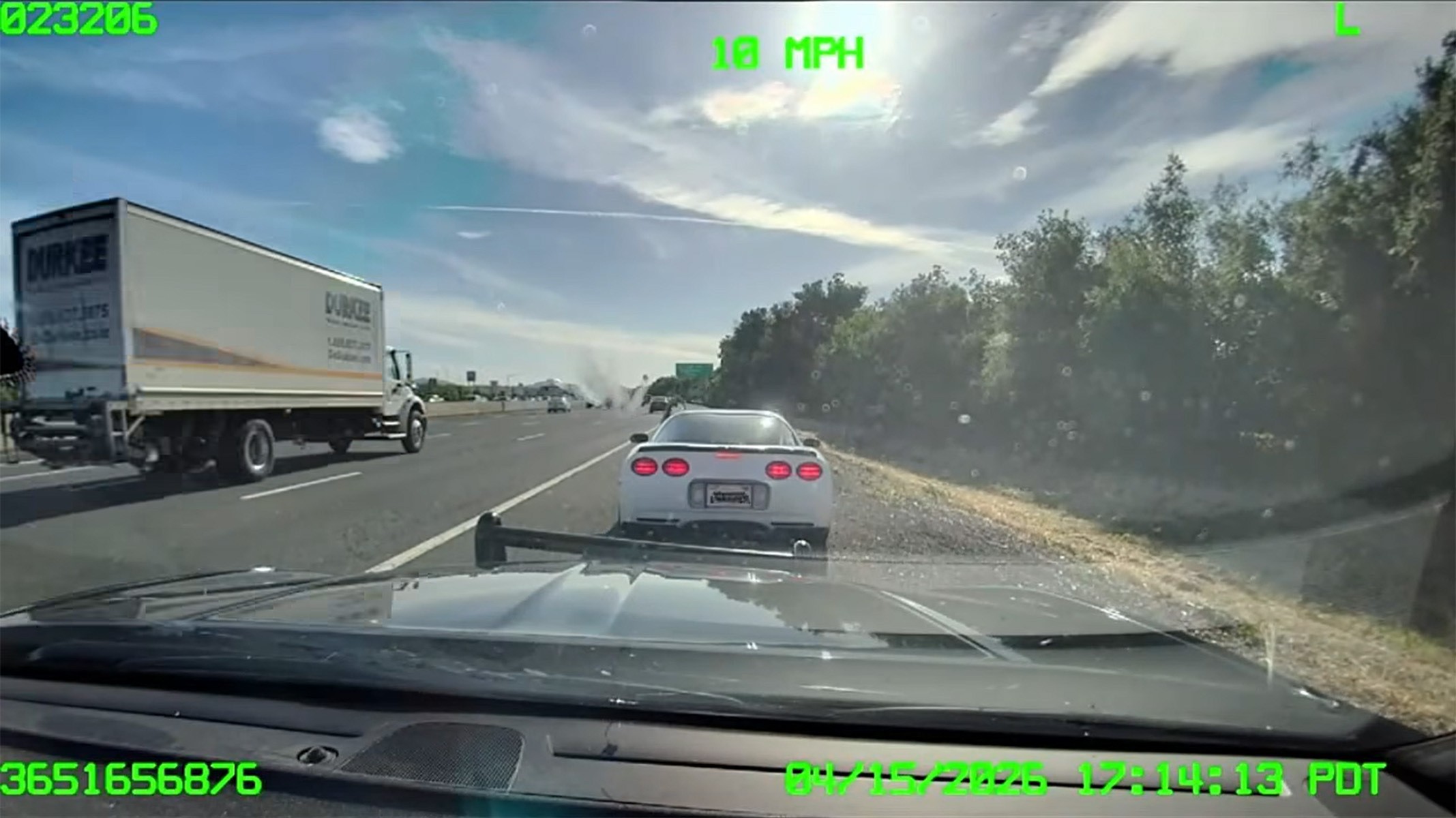
A recent incident involving a Chevrolet Corvette on a California highway has highlighted a critical distinction in American traffic law: the massive difference between receiving a citation and being placed under arrest.
While the driver of the C5 Corvette managed to avoid handcuffs, the financial and legal fallout serves as a stark reminder that “getting away with it” is a matter of perspective.
The Incident: 148 MPH on a Public Highway
The California Highway Patrol (CHP) Solano division recently released dashcam footage of a high-speed interception. The video shows a CHP officer positioned on the left shoulder when a Corvette suddenly blitzes past at a velocity far exceeding the flow of traffic.
According to official CHP data, the vehicle was clocked at 148 mph (238 km/h). The officer quickly maneuvered to intercept the vehicle, initiating a traffic stop that would ultimately result in significant legal and financial penalties for the driver.
Legal Nuances: California vs. Florida
This incident highlights how much state-level legislation dictates the immediate consequences of extreme speeding. The legal outcome of this stop depends entirely on the geography:
- In Florida: Extreme speeding often crosses the threshold into criminal territory. A driver clocked at these speeds would likely face immediate arrest and potential jail time.
- In California: Speeding, even at much higher velocities, is rarely an arrestable offense on its own. For an officer to make an arrest, they must typically prove reckless driving, which requires evidence of additional dangerous behaviors, such as weaving through traffic or tailgating other vehicles.
Because the driver in this instance was not necessarily exhibiting “reckless” maneuvers beyond the speed itself, the officer was able to issue a citation rather than taking the driver into custody.
The Long-Term Consequences
While the driver avoided jail, the CHP emphasized that the “cost” of the high-speed run is far from negligible. The driver is now facing a cascade of repercussions:
- License Points: The driver will receive two points on their license. While this may seem minor to some, it can be catastrophic for professional drivers holding a Commercial Driver’s License (CDL).
- Administrative Suspension: Under relatively new California laws, the DMV has the authority to suspend a driver’s license before a case even reaches a courtroom.
- Financial Impact: Beyond steep court fines, the driver is facing a massive spike in insurance premiums—a long-term penalty that often outweighs the immediate fine.
“Save the high speeds for the track,” the CHP advised, noting that the consequences of public road speeding are far more punishing than most drivers realize.
Conclusion
This incident demonstrates that while California’s laws may prevent an immediate arrest for high-speed driving, they do not grant immunity from severe penalties. Between DMV administrative actions and skyrocketing insurance costs, a few seconds of extreme speed can result in months of legal and financial instability.