


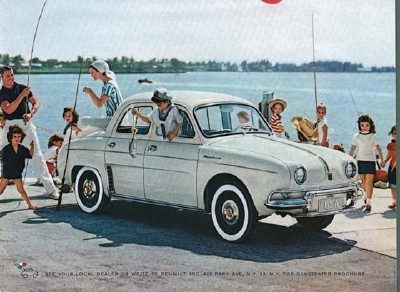
Renault didn’t just stumble into the rear-engine game. They studied the blueprints with the 4CV, a tiny, utilitarian bubble car that survived the chaos of post-WWII Europe. It taught the engineers everything they needed to know about packaging, cooling, and traction without a front engine weighing down the nose.
By 1955, they were ready to scale up.
The result hit showrooms in 1956. It was the Renault Dauphine.
Smaller than the later 16, but significantly larger than the 4CV. It had a proper trunk. It had space for four adults without them feeling like sardines. And it kept that rear-mounted, air-cooled flat-twin engine layout that defined the brand’s identity for the next decade.
Success wasn’t guaranteed. The automotive market in the mid-50s was getting crowded. But the Dauphine hit a sweet spot. It was affordable. It was modern looking. And it worked.
Sales figures would eventually prove it outperformed its predecessors, but the initial reception was key. Buyers wanted something that felt like a step up from the 4CV without the price tag of a full-sized sedan. The Dauphine delivered.
It wasn’t just a car. It was a statement that French engineering could compete with the German and British offerings that dominated the export market.
The Beetle’s Shadow and France’s Rebirth
Dr. Ferdinand Porsche left a massive footprint on automotive history, and it starts with the Volkswagen Type 1. Without that tiny rear-engine sedan, the entire trend of compact rear-wheel-drive cars might have never caught on. No Beetle means no Chevrolet Corvair, no Renault 4CV, and likely no 1955 Renault Dauphine.
It seems ironic that such a charming, stylish little car emerged from a nation in ruins. France had just survived four years of Nazi occupation. By the time the 4th Infantry Division liberated Paris in August 1944, the country was barely standing. Factories were either sabotaged by resistance fighters or leveled by Allied bombers.
Louis Renault, the company’s founder, was imprisoned as a suspected collaborator. He died in custody. The state stepped in, nationalized the wreckage, and put Pierre Lefaucheux in charge. He had to rebuild from scratch. Up to a third of the machinery was gone. The rest was flattened.
Yet, by 1947, Renault released the 4CV. It was a direct response to the German “people’s car.” Renault had actually asked his engineers in 1940 to design something similar to the Beetle. Development happened in secrecy while the Nazis wanted military trucks. In a twist of fate, Porsche himself helped refine the 4CV. While imprisoned by the French in 1946, he reviewed the drawings. He suggested tweaks to improve weight distribution and road holding. He even worked in Renault’s engineering shops for a time.
The 4CV was cute. Snub-nosed, Beetle-tailed. It wasn’t fast, and it didn’t handle well. But it was cheap, reliable, and available. More importantly, it proved the concept. Almost every design element was kept, improved, and reused for the next project.
The R1090 Project
By 1951, the Renault Dauphine development project—code-named R1090—began in earnest. Renault wanted a successor. Not just a facelift. A true evolution.
Testing started early. A prototype rolled out in July 1952. The company didn’t skimp on validation. They clocked over 2 million miles of testing. Conditions were extreme. One car went to the North Cape for Arctic trials. Another tackled the Swiss mountains. A third drove through the United States. A fourth braved the dusty roads of Africa.
This rigorous process took time. The first production model finally rolled off the new assembly line in Flins in December 1955.
Renault had initially wanted to name the car “Corvette.” General Motors beat them to it. So, the company looked to its own history. France was a republic, but it still cherished its royal past. A “dauphin” was the heir to the throne. The “dauphine” was the feminine equivalent. It sounded elegant. It fit the car’s appeal.
The result was a small rear-engined car that carried the DNA of the 4CV but looked nothing like its predecessor. It was sleeker. More modern. And it proved that French industry could rise from the ashes.
Why the Dauphine Matters
The 1955 Renault Dauphine wasn’t just a car. It was a statement. It showed that France had recovered. That its engineers could innovate. That it could compete with the Germans.
Porsche’s influence lingered in every line. The rear-engine layout. The independent suspension. The focus on lightweight materials. These weren’t random choices. They were lessons learned from the Beetle. Lessons that Porsche helped Renault refine.
The Dauphine was a bridge. Between the war-torn past and a prosperous future. It paved the way for later models. It established Renault as a serious player in the small car market.
And it did all this while looking good doing it.
Key Specs and Context
- Engine: 425cc air-cooled flat-twin
- Power: Around 21 horsepower
- Layout: Rear-engine, rear-wheel drive
- Production Start: December 1955
- Assembly: Flins plant
The car was affordable. It was practical. It was also undeniably pretty. In a market dominated by larger, heavier vehicles, the Dauphine offered something different. Something light. Something agile.
It wasn’t perfect. Handling could be nervous at the limit. Power was modest. But for everyday driving, it worked. It solved a problem. It gave people mobility.
That’s what cars are for. Not just speed. Not just style. But function.
The Dauphine delivered.
The 1956 Renault Dauphine: Beauty with a Deadly Twist
The French loved it. When the Renault Dauphine debuted in March 1956, it arrived as Renault’s “princess,” wrapping a utilitarian mechanicals package in genuinely pretty, curvaceous sheetmetal. But beneath that stylish exterior lay a chassis that would define its legacy—and its dangers.
The engine remained the conventional “Ventoux” OHCI inline-four. It was water-cooled, featured removable cylinder sleeves, and lived where it always had: in the rear. Compared to its predecessor, the 4CV, the Dauphine grew significantly. The wheelbase stretched to 89 inches, adding 6.3 inches of length. Overall, the car was a full foot longer, wider, and slightly lower than the aging 4CV, which stayed in production until 1961.
The result was a vehicle that looked far more upscale than its price tag suggested. It swallowed passengers and luggage with ease and could cruise France’s tree-lined Routes Nationales at speeds exceeding 60 mph. It was a modern, fashionable machine for a recovering French economy.
But Renault had a fatal flaw in its engineering philosophy. They knew about as much as Dr. Porsche did about managing tail-heavy vehicles with swing axles. Mounting a heavy engine and gearbox at the rear, while the front sheetmetal surrounded nothing but empty air for storage, created a dangerous weight distribution.
Nearly 62 percent of the Dauphine’s weight sat over the rear wheels. The suspension was simple high-pivot swing axles. These wheels struggled to maintain traction and stability under stress. Every rumor about the car’s nervousness was true. Overtaking a semi-truck on the highway? Skittish. Crossing a high, exposed bridge? Terrifying.
Even the specific tire pressure recommendations—15 psi in the front, 23 psi in the rear—failed to tame the handling issues.
Early US road tests praised the Dauphine. By 1960, however, Motor Trend had changed its tune.
“There is nothing in the handling at normal speeds to indicate that the engine is stowed in the rear but push up to some high-speed cornering and the rear end becomes quite skittish, requiring skilled control of an oversteer condition that presents itself.”
Under the Skin of the Dauphine
The body was a unit-construction shell, but it relied on two longitudinal box sections shaped like a perimeter frame, welded together with substantial cross-bracing. Inside the extreme tail lived the 845cc four-cylinder engine. This was essentially the 4CV powerplant with larger bores.
Cooling was managed through vents in the engine lid—a part we might call a trunklid, though in the Dauphine, the actual trunk was at the front. Air intakes were cleverly hidden in the rear passenger doors to give away the rear-engine layout. Power went to the rear wheels through a three-speed transaxle mounted just ahead of the engine. Drivers often wished for a fourth gear; even Road & Track and Motor Trend noted its absence in 1956.
There was a technical oddity available: the Ferlec clutch. It featured automatic electromagnetic operation, meaning there was no separate clutch pedal.
Accessing cargo was easy via the front-hinged trunklid, which housed the headlights. Flip it up, and you found a seven-cubic-foot hold. The spare tire rode sideways under the front of the car, hidden behind a pivoting panel below the bumper’s center section.
The suspension setup was a mix of sensible engineering and bizarre choices.
Up front, it was conventional. Coil springs and wishbones paired with an antiroll bar. Rack-and-pinion steering sat on a detachable front cross member. Clean. Standard.
At the rear? Pure chaos.
The high-pivot swing axle was as simple as it got. Concentric coil-springs and telescopic dampers sat atop the swing tubes, which Renault called “trumpet casings.” There was no fore-and-aft location for the axle, except for the trunnion arms built into the transaxle housing. The entire pressed engine, transaxle, and suspension member was a detachable unit from the main body structure.
Then there were the wheels. Carried over from the 4CV, the axle hubs were large with five widely spaced bolt locations. The wheels themselves were sturdy rims with five matching lugs. The space in the middle? Pure fresh air.
Built to Rust, Built to Sell
Technically, the Dauphine might have looked elegant on paper. It was cheap to build. But it wasn’t built to last.
The front end looked flimsy. In a head-on collision, that hollow nose would fold up toward the windshield with alarming speed. Customers quickly discovered that body panels had an alarming tendency to rust away.
None of this mattered to the public. The Dauphine arrived at the right moment. France’s economy was picking up. The world craved modern-looking cars. The Dauphine became fashionable instantly. Paris and other French cities soon teemed with these little four-seaters. It was a commercial success story written in steel, rust, and skid marks.
The Dauphine’s American Dream and the Gordini Upgrade
Production numbers for the Renault Dauphine climbed steadily. By March 1957, Renault had rolled out its 100,000th unit. Daily output sat at around 700 cars. The French automaker knew how to handle the press. They got Brigitte Bardot photographed sitting in a Dauphine. It was classic marketing. On the track, a works team of five modified Dauphines swept the first four spots in their class at the 1956 Mille Miglia. The fourth-place car survived a nasty tumble into a ravine. The others just kept going.
Renault expanded kit assembly to England and Italy. They looked west, too. The car debuted at the 1956 New York Auto Show in April. The plan was to sell big numbers in the USA.
Could they have been serious? Could they really expect a 30-horsepower machine to take over Main Street, USA? A car that took roughly 31 seconds to hit 60 mph? One that struggled to keep pace with a Checker cab? They thought so. They were wrong.
American drivers hit a wall quickly. Second gear maxed out around 45 mph. The experience felt vulnerable. The only saving grace was frugality. The base price was $1,645. That was $150 more than a base Volkswagen Beetle. Yet, magazine tests showed mixed-use fuel economy hitting 39.1 mpg.
Glamour followed speed. Renault hired Amedee Gordini, a French racer who had just walked away from Grand Prix duties and needed work. The result arrived in September 1957: the Dauphine-Gordini.
It wasn’t just a badge change. Gordini installed a different cylinder head. The engine pushed 38 bhp. That is a 27 percent jump over the standard model. They also fitted a four-speed gearbox. The top speed climbed to 74 mph. Finally, you could keep up with larger engines in America. The Gordini variant also proved its worth by winning the 1958 Monte Carlo Rally.
The Floride and Sixties Suspension Changes
More than a year later, Renault added the Floride. In the USA, these were called Caravelles. Styling came from Frua. Body shells were built by Brissonneau et Lotz. You could get it as a 2+2 coupe or a two-seat convertible. Both sat on the Dauphine platform but used more power. For a while, owning a Floride was the status symbol in Paris or French coastal resorts.
The 1960s brought changes to the chassis. Renault introduced the “Aerostable” suspension for the 1960 model year. It wasn’t a revolution. The swing-axle rear end stayed. Instead, they added rubber springs up front. At the rear, they mounted auxiliary air spring units inside the conventional coils.
The setup softened the ride in normal conditions. It firmed up quickly under heavy load. For sporty drivers, there was a specific benefit. With just two people inside, the rear wheels gained slight negative camber. That meant more grip when cornering.
It was a step up from the agricultural handling of the early models. But the American dream of dominating US streets remained firmly out of reach. The Dauphine stayed a European story, albeit a popular one.

The Gordini’s Final Hurrah and the Dauphine’s Late Evolution
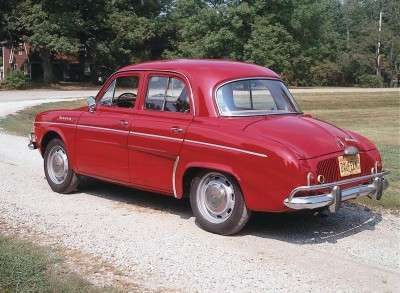
By the mid-60s, Renault had squeezed everything it could out of the tiny 845cc engine. The base Dauphine managed 32 bhp, but the Gordini badge carried a more potent 40 bhp tune. Interestingly, the Gordini had abandoned its unique castings by then, borrowing its powerplant directly from the Dauphine Caravelle instead. Performance numbers? Around 20 seconds to 60 mph and a top speed hovering near 80 mph. Not exactly sports car territory, but respectable for a bubble car.
Production numbers tell a different story of success. Renault was churning out over 200,000 units annually. The one-millionth Dauphine rolled off the line in 1960. You’d think that kind of volume breeds complacency, but the Régie kept tweaking the formula.
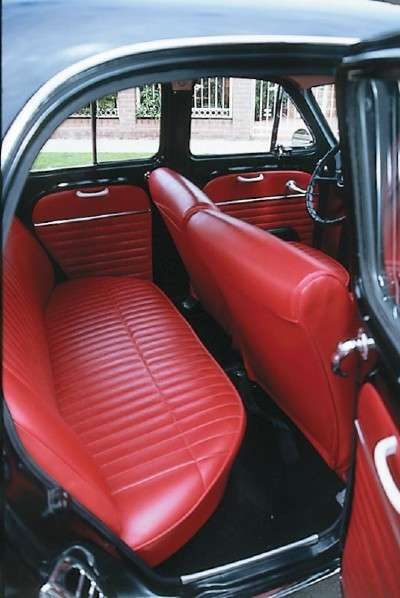
In 1961, the Ondine variant appeared. It looked like a standard model but hid a four-speed gearbox taken from the Gordini, offering sharper shift engagement for those who cared. Later that same year, the DeLuxe trim hit the market. It wasn’t just a badge change; it offered reclining front seatbacks, a lined luggage area, upgraded interior trim, and whitewall tires as standard equipment.
The following year, 1962, brought mechanical refinements to the base model with an all-synchromesh three-speed transmission. But the real headline was the limited-edition Dauphine R1093. The “R” stood for Rally. This version produced a massive 55 bhp—enough to crack 90 mph. Unfortunately, the vast majority of these hot rods never left France. Export fans missed out on what was arguably the quickest small Renault of the era.
By 1964, the Dauphine was no longer fighting for relevance against the R8 sedan. The R8 was newer, larger, and featured updated suspension derived from the Dauphine’s original mid-1962 overhaul. The Dauphine didn’t try to outgrow the R8; it just matured. For 1964, it adopted the R8’s four-wheel disc brakes.
This upgrade solved one of the car’s most glaring flaws. Stopping power was finally up to the task of its brisk acceleration. New options for the year included air conditioning and a pushbutton-controlled three-speed automatic transmission mounted on the dashboard. It was a well-matured package now. It looked good, it stopped well, and it was quick enough for city duty.
But the elephant in the room remained handling. The rear-engine layout always made the Dauphine twitchy on limit. If only Renault had listened to the critics earlier. Porsche managed to tame that same layout in their sports cars. Why couldn’t Renault? The car was good, but that lingering instability kept it from being truly great.

The Decline of a French Icon
By the mid-Sixties, the clock was ticking loud and clear for the Renault Dauphine. It had spent nearly a decade on the assembly line with zero significant styling updates and barely any performance gains in its base form. The car’s reputation was taking a hit from rust, too. The lightweight construction, which enthusiasts sometimes called fragile, was starting to show its age with serious body corrosion.
Renault wasn’t exactly coming to the Dauphine’s defense, either. The company was effectively cannibalizing its own sales. Below it sat the new front-wheel-drive R4. Above it was the more spacious and capable R8. The Dauphine was squeezed out of the lineup by its own successors.
The American Market Crash
Demand in the U.S. cratered for several reasons. In the early Fifties, Renault sales were negligible, hovering in the hundreds. But by the late Fifties, as Americans flocked to economical European imports, the Dauphine led the charge. Renault sold 91,073 cars in America in 1959. That number collapsed to just 12,106 by 1966.
Domestic compacts from Ford, Chrysler, and Chevrolet joined existing small cars like the Rambler and Studebaker in 1960. Every import suffered. Even Volkswagen took a hit. Renault dropped prices in 1961 to no avail. The Dauphine just couldn’t compete with the sheer volume and familiarity of American metal.
Service Nightmares
It wasn’t just competition. Renault’s U.S. service network was a disaster. The company even admitted it in marketing materials for the 1967 Renault 10. “Our [earlier] cars were not fully prepared to meet the demands of America,” the ads read. “More than a fair share of things went wrong with our cars. Less than a fair share of our dealers were equipped to deal with what went wrong.”
They begged former customers to give them another chance. It didn’t work immediately. Renault wouldn’t see high U.S. sales again until the early Eighties, when AMC manufactured and sold the cars.
The Final Run
Production of the base Dauphine ended in December 1966. The high-performance Gordini versions hung on until 1968. In total, about 2 million Dauphines were built. It was a commercial success by any metric. But Renault never quite recaptured that specific charm in later years. The little sedan remained unique.
1956-1968 Renault Dauphine Specifications
The Dauphine enjoyed a long run. Here are the specs for the 2 million units built between 1956 and 1968.
General Dimensions
- Wheelbase: 89 inches
- Overall Length: 155 inches
- Overall Width: 60 inches
- Overall Height: 57 inches
- Tread (Front/Rear): 49/48 inches
- Curb Weight: 1,324 lbs
- Weight Distribution: 39% Front / 61% Rear
- Cargo Space: 7 cubic feet
Construction
- Layout: Rear-engine, rear-wheel drive
- Type: Unitized
- Body Material: Steel
Engine Details
- Type: Inline OHV 4-cylinder
- Block/Head: Cast-iron block, aluminum head
- Bore x Stroke: 58 mm (2.288 in) x 80 mm (3.15 in)
- Displacement: 845 cc (51.5 cid)
- Horsepower: 30 hp @ 4,250 rpm (U.S. spec; 26 hp for others)
- Torque: 48.5 lb-ft @ 2,000 rpm
- Compression Ratio: 7.25:1
- Main Bearings: 3
- Valve Lifters: Mechanical
- Carburetor: 1-bbl Solex downdraft
- Electrical System: 6-volt
Drivetrain
- Transmission: 3-speed manual, synchromesh, floor-mounted
- Gear Ratios: 1st 3.70:1; 2nd 1.81:1; 3rd 1.07:1; Reverse 3.70:1
- Axle Ratio: 4.37:1
Suspension
- Front: Independent coil-spring and wishbone with anti-roll bar and tubular shock absorbers
- Rear: Independent swing axle with coil springs and tubular shock absorbers
Brakes and Tires
- Brake Type: 4-wheel hydraulic drum
- Brake Diameter (Front/Rear): 8.9 inches
- Brake Swept Area: 133 sq in
- Tire Size: 5.00 x 15
Steering
- Type: Rack and pinion
- Turns, Lock-to-Lock: 4
- Turning Diameter: 29 feet


