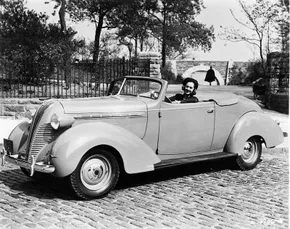
Roy D. Chapin, the president of Hudson Motor Car Company, watched the success of the 1932-33 Essex Terraplane and decided to strip away the “Essex” part. By 1934, the brand was simply Terraplane. This wasn’t just a name change. It was a strategic pivot that literally kept the company alive.
The engineering backbone changed too. Hudson ditched the older 193-cubic-inch six and the 244-cid eight. They replaced them with a new long-stroke six. This 212-cid engine made 80 to 85 horsepower. It climbed to 88 bhp in 1935 and 1936. By 1937, power hits were 96 and 102 bhp. The Terraplane became a Hudson, but as a separate make, it carried the weight of the firm.
Pricing and Lineup Evolution
Essex Terraplanes had been cheap, starting at $425. The 1934 successors moved upmarket. Prices now ranged from $565 to $880. The lineup got more complex. You had the Special and the Challenger on a 112-inch wheelbase. Above them were the Major models on a 116-inch chassis.
The Major was gone by 1935. The Challenger was renamed DeLuxe. In 1936, the line shifted again. DeLuxes sat on a new 115-inch platform. Customs joined them as the uplevel option. The 1937 DeLuxe and Super models used a chassis stretched two inches to 117 inches.
Body Styles and Design
Terraplanes followed design trends of the late 1930s without going over the top. The 1936-37 grille, often called the “fencer’s mask,” remains debatable. Some love the look. Some hate it.
Roadsters and phaetons were never on the menu. Instead, buyers got brougham and coach sedans. These came in regular and trunkback “touring” forms. Fixed-roof and convertible coupes were standard fare. A smart victoria appeared for 1934 only. The 1936 DeLuxe wood-bodied station wagon was exclusive to that year. In 1937, a few chassis went to commercial applications.
Performance Data
The performance was solid for the era. A British road test of a 1936 Terraplane sedan tells the story. It hit 0-60 mph in 26.6 seconds. Top speed was 82 mph. Considering the car weighed about 2,800 pounds, those numbers are creditable.
“The six-cylinder engine…has that suppleness and quietness in it’s running that are characteristic of American design…Even at 70 there is no special fuss…[The Terraplane] can thus be a decidedly swift car for journeying over long distances, and is an easy one to handle, too…[It] gives, and does, much for its price.”
The reviewer noted the engine’s quietness. It didn’t fuss at highway speeds. It was easy to handle. It delivered value for the money.
Sales Volume and Legacy
Terraplane drove Hudson’s volume. It accounted for nearly 280,000 total sales over four years as a separate make.
- 1934: ~51,000 units
- 1935: ~51,000 units
- 1936: ~87,000 units
- 1937: 90,253 units
By 1938, the other junior editions were dead. Terraplanes got Hudson badges. The lineup expanded to include Standard, DeLuxe, and Super models. Power increased by eight horsepower. But the 1938 Terraplane faced a new problem. The new “112” line made Terraplane neither the smallest nor the cheapest Hudson.
Sales disappointed. The name was dropped. But it didn’t vanish entirely. The spirit survived in the 1939 Series 91 Pacemaker and Series 92 Six. The brand had done its job. It kept the lights on. Now the question is, did the engineering improvements stick around? Or did they fade with the badge?