


William Lyons hated copies. When he founded Jaguar, the rule was simple: build a car that stands alone, an art object on four wheels. That philosophy held the brand together for nearly nine decades. Now, facing a harsh reality check, Jaguar is stripping everything back. No more sprawling lineup. No more incremental updates. Just one car. And a brand new identity.
The brand is pivoting hard toward an “exuberant modernism.” To signal the shift, they debuted a new logo. But the real statement isn’t the badge. It’s the Jaguar Type 00.
They didn’t show it at Geneva or Detroit. They skipped the auto shows entirely. Instead, the concept dropped during Miami Art Week. This wasn’t a mistake. It was a message. The Type 00 isn’t just a vehicle. It’s a physical manifestation of what Jaguar wants to be. Uncompromising. Unexpected. Spectacular.
The Design Language Of The Jaguar Type 00 Concept
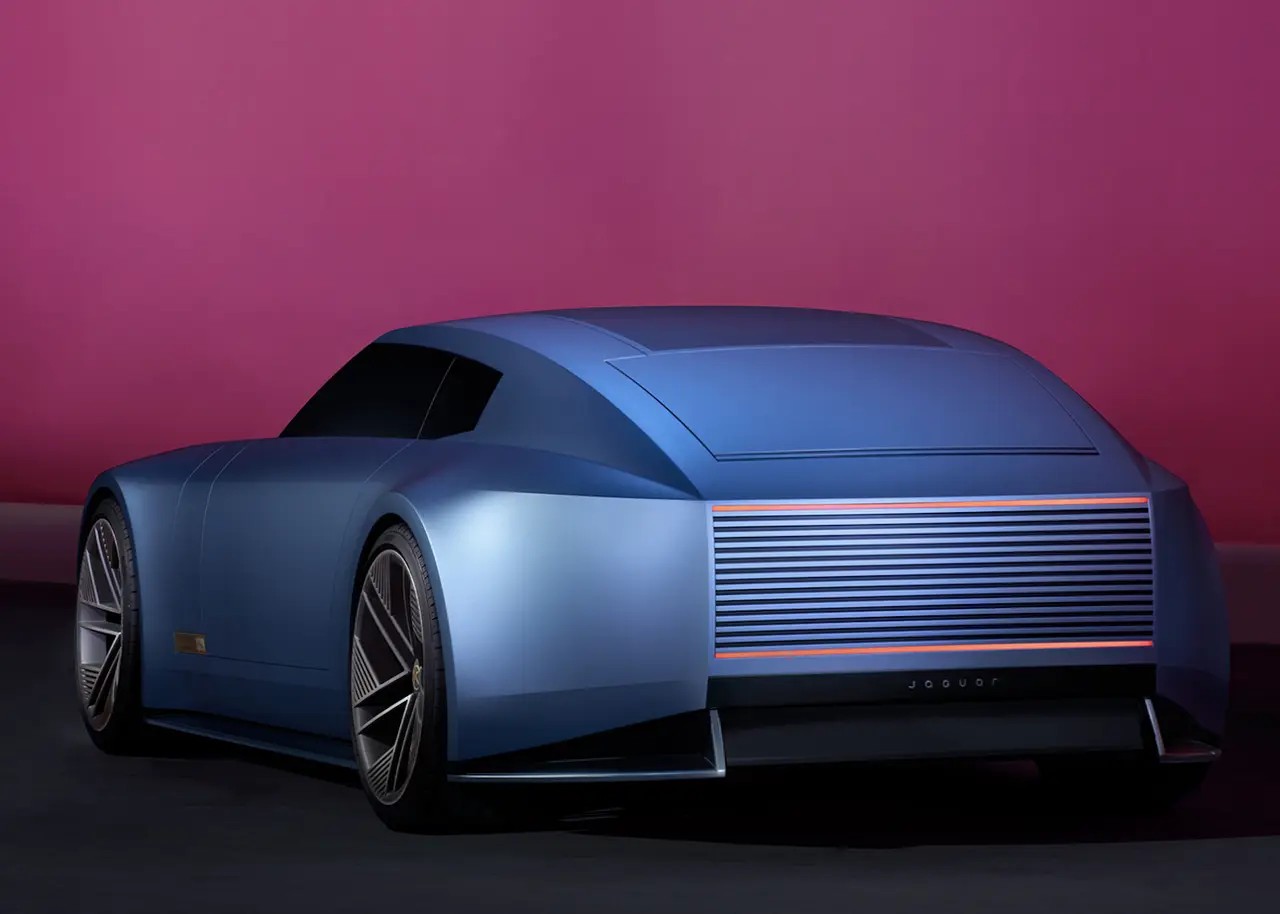
The silhouette is long, low, and sharp. At five meters, it carries the classic long-hood profile but executes it with brutalist precision. There are no rear windows. No side mirrors. Just clean surfaces that flow into each other.
Visibility comes from cameras housed in brass ingots. These aren’t static parts. When you start the car, the ingots deploy. They slide out to reveal the iconic leaping jaguar emblem just ahead of the butterfly doors. When you kill the engine, they retract. Even the front air intakes seal themselves shut when the car is parked. It looks like a sculpture. It breathes only when alive.
The front end is vertical, almost aggressive. Horizontal lines cut through the grille, continuing across the roof and wrapping around the rear. The taillights aren’t clusters. They’re continuous lines spanning the full width of the car.
But here is where the design gets weird. And by weird, we mean bold.
“The interior is a mix of art and luxury.”
Stone, Brass, And Digital Totems In The Cabin
Open the rear flank panel. Behind it sits a row of “totems.” Some are brass. Others are carved from travertine stone or alabaster.
You don’t just look at them. You take one.
Pull a totem out and slide it into the center console. The car reacts. The ambient lighting shifts. The screen graphics change. Even the scent system adjusts to match the material you inserted. It’s haptic customization. You change the soul of the car by plugging in a piece of rock.
The cabin feels floaty. The seats seem to hover. They’re wrapped in wool with no visible stitching. A strip of brass runs down the center, tying the interior back to the exterior hardware. It’s minimalist, but heavy on texture. Not every surface is smooth black plastic. It’s warm. It’s tactile.
Electric Specs: 1,000 HP And Fast Charging
Under the skin, the drama is pure electricity. Jaguar claims the Type 00 will produce 1,000 horsepower. That’s serious torque. Enough to make the heavy stone interior feel light.
Range is set at 692 kilometers (roughly 430 miles). That’s competitive for a luxury GT. But the real flex is the charging speed. Plug it in for 15 minutes, and you get 200 kilometers of range back. That’s enough for a serious cross-country leg without stopping for hours.
This isn’t a prototype that will sit in a museum. Jaguar plans to launch a production version inspired by the Type 00 by the end of next year. The price tag remains unknown, but given the materials and the positioning, expect it to be steep.
The brand is betting its survival on this single direction. No SUVs to dilute the image. No sedans to chase volume. Just high-end, electric, artistic machines.
It’s a risky move. It’s also the only move that makes sense for a brand that refuses to copy anyone.
The question isn’t if the car is beautiful. It’s whether the world is ready to buy a car that treats interior customization like an art installation.
Jaguar thinks so. We’ll see if the market agrees when the production model arrives.


