The eagle isn’t just America’s national bird. It’s a symbol that has graced everything from cheap pencils to luxury potato chips. And cars. Lots of them. Before World War I, six different automakers slapped the bird on their hoods. Four of those were right here in the U.S. Durant Motors ran an Eagle line in the early 20s. Chevrolet used the badge for its top-tier 1933 models. Even Dan Gurney’s All-American Racers used it for competition builds in the late 60s.
But none of that matters for the Eagle we’re talking about.
The relevant Eagle is the one born out of corporate desperation. Chrysler bought American Motors Corporation (AMC) from Renault in 1987. They wanted Jeep. Specifically, the lucrative Jeep franchise. But the purchase came with baggage. AMC held the rights to the Eagle name, a title passed down through a tangled web of mergers.
It started with Willys and its Aero-Eagle passenger cars in the early 50s. Kaiser bought Willys. Then AMC bought Kaiser-Jeep in 1970. AMC had already played with the name, slapping it on a fancy CJ-7 and later a line of four-wheel-drive passenger cars in 1980.
Chrysler inherited AMC’s dealer network too. Those dealers were used to selling cars, not just Jeeps. Even as Jeep sales climbed, the dealers needed passenger vehicles to stay profitable. So Chrysler created a new division: Jeep-Eagle. Eagle became a full-fledged car make. The plan? Position it as an upscale brand to compete with imports. Toyota, Honda, Nissan. The goal was to stop the bleeding from Dodge and Plymouth while capturing the fast-growing import market.
What cars launched the Eagle brand in 1988?
The launch in model year 1988 was less a grand unveiling and more a salvage operation. Chrysler couldn’t keep the old AMC Eagles. They were dead on arrival. The small Renault Alliance and Encore, built in Kenosha since 1983, were too problematic to continue.
That left two survivors from the Renault era.
The Medallion. A compact four-cylinder. Basically a federalized Renault 21 imported from France.
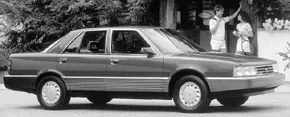
The Premier. A midsize V-6 notchback. Built in Canada, based on the European Renault 30, and styled by Giorgetto Giugiaro. Yes, the same Giugiaro. The styling was surprisingly dull.
Both were front-wheel-drive Renault designs. Rushed to the U.S. just before the Chrysler buyout to stop AMC’s declining sales. For 1988, they became Eagles by virtue of a new badge. It was a handsome badge. The cars were not.
They sold poorly. Why? They were conventional Renaults. But to American buyers, they were still too quirky. The workmanship was questionable, especially on the Medallion. That car vanished after 1989. A quick exit.
The Premier stuck around longer, lasting until 1992. Only because Renault forced Chrysler to keep building it as part of the buyout deal. Chrysler tried. Production peaked in 1988 at roughly 59,000 units. Then sales plummeted. Even adding a Dodge duplicate called the Monaco in 1990 didn’t save it.
It’s a strange footnote in automotive history. A brand built on a bird name, founded on French engineering, and strangled by corporate mandate.
The Premier lasted only because Renault insisted. Chrysler tried to satisfy the condition. It was a tough job.
Sales went downhill fast. The question isn’t just why they failed. It’s why anyone thought replacing a badge would fix the underlying issues.

Eagle Talon and Eagle Vision
Chrysler tightened its focus on import buyers by leaning hard on Mitsubishi. The strategy was simple: take contemporary Japanese designs, slap an Eagle badge on them, and sell them as front-wheel-drive staples. Most of this lineup stayed in Japan. The subcompact Summit sedan, launched in 1989, was a direct clone of the Mitsubishi Mirage. Then there was the Summit wagon. A short-lived “mini-minivan” from the early ’90s. It borrowed its bones from the Mitsubishi Expo LRV.
The Talon and Vision represented the sharper end of this badge-engineering experiment.
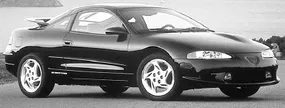
The Eagle Talon arrived as the sporty counterpart to the Mitsubishi Eclipse. It shared the same platform, the same engines, and much of the same DNA. But Chrysler wanted it to feel distinct. The front end was restyled. The interior got tweaks. It wasn’t just a sticker swap. Enthusiasts saw it as a viable alternative to the Eclipse. Sometimes cheaper. Sometimes with different trim packages.
The Talon proved that badge engineering could yield two distinct personalities from one chassis.
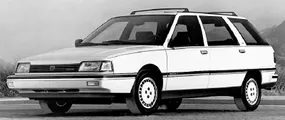
The Eagle Vision was the odd duck. A mid-size wagon with a sliding side door. It looked like a station wagon had a baby with a minivan. Built on the same platform as the Mitsubishi Galant and Eagle Summit, it offered practicality with a weird aesthetic. The sliding door was the headline feature. It made loading easier. It also made the car stand out in a parking lot. Sales were modest. It served a niche market. Families who wanted wagon aesthetics but minivan convenience.
Both cars highlight a specific era in automotive history. When domestic brands needed to compete with Japanese reliability and style. Eagle borrowed. Sometimes heavily. But it delivered cars that were mechanically sound. The Talon offered performance. The Vision offered utility. Neither was perfect. Both were products of their time.
The Talon eventually faded as the Eclipse grew in popularity. The Vision disappeared entirely. Mitsubishi moved on. Chrysler restructured. Eagle became a footnote. But for a few years, these cars offered a unique blend of Japanese engineering and American marketing.

The Vision: Detroit’s Attempt at a Euro-Sedan
The Talon was the outlier. A sharp sports coupe that debuted in early 1989, it was essentially a rebadged Mitsubishi Eclipse or Plymouth Laser. Built in Illinois at the Diamond-Star Motors joint venture plant, it handled like a Japanese car. Even in its turbocharged all-wheel-drive glory, it didn’t fit the Eagle mold. It was an enthusiast’s toy, sure, but ultimately an import in disguise.
Then came the Eagle Vision.
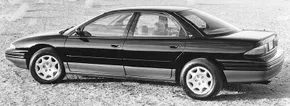
Launched for the 1993 model year, this was the first true American Eagle. Built in Canada, yes, but designed in Detroit. It belonged to the LH platform family, the “cab-forward” sedans that changed Chrysler’s styling direction. The vision here was specific: make a car that felt European without actually being one. It sat between the Chrysler Concorde and the Dodge Intrepid in the lineup.
The trim levels told the story. You had the ESi with a 3.3-liter pushrod V-6. Or the TSi, which got the twin-cam 3.5-liter V-6. The goal was to position the Vision as more refined, more precise than its corporate cousins.
Was it a BMW? No. But it wasn’t trying to be. The Eagle Vision driving experience leaned into crisp handling rather than raw power. The wide-stance LH chassis with all-independent suspension made the car feel responsive. The TSi added standard all-disc ABS brakes. By 1994, speed-variable power steering became standard. It was brisk. Not thrilling. But competent.
The design helped sell the idea. The swoopy cab-forward shape stretched over a long 113-inch wheelbase. Inside, there was room for five adults. Unusually spacious for a sports sedan of that era.
The downsides? Road noise. It was loud. And some of the interior trim felt cheap, lacking the upscale touch the marketing promised. Still, Consumer Guide named it a “Best Buy” alongside the Concorde and Intrepid. It was an impressive package.
Sales told a different story.
The Vision finished third in the LH trio. It sold for only 30-40% of the Intrepid’s volume. Production hovered around 30,000 units for 1993, 1994, and 1995. Why? Price. Eagle dealers struggled to convince buyers the Vision wasn’t overpriced.
Chrysler argued the Vision came with more standard equipment than the Intrepid or Concorde. They urged dealers to explain the value proposition. Buyers didn’t care. Production for the 1996 and 1997 model years combined dropped to about 15,500 units.
The updates did little to stop the bleed. The 1996 ESi got 16-inch wheels as standard and Chrysler’s AutoStick feature, allowing manual-like shifting of the automatic transmission. Good upgrades. The 1997 models were essentially carryovers. Meanwhile, Talon sales were languishing.
By the end of 1997 for the Vision and 1998 for the Talon, the brand was dead.
The decision wasn’t just about bad cars. It was about overhead. Chrysler wanted to trim its dealer network. Combining Jeep-Eagle stores with Chrysler-Plymouth outlets made financial sense.
It turned out to be a smart move. SUVs were booming. Jeep’s image was golden. The new consolidated dealerships were more profitable than the separate entities. The accountants were happy. The Eagle nameplate, once a promising idea ten years prior, faded into history.

Why the Eagle brand collapsed
Chrysler never quite figured out what an Eagle was supposed to be. The public certainly didn’t. With a lineup that felt thrown together and marketing that was sporadic at best, the brand signaled indifference from the top down. Consumers were left guessing. If you heard the name Eagle, did it mean reliability? Style? Value? Nobody knew.
The cars themselves weren’t junk. They were solid. But they lacked the cool factor of the Japanese imports and didn’t have the established identity of domestic rivals either. Eagle wasn’t a disaster on the scale of the Edsel, sure. But it proved a simple point. You don’t get respect for a badge just by slapping it on metal. You have to earn it.
Other American brands that disappeared
Eagle isn’t alone in the graveyard of American automotive history. Plenty of names once dominated the streets, only to fade into memory.
- AMC – The scrappy underdog that built the Jeep Cherokee and Eagle.
- Duesenberg – The ultra-luxury icon that went bust in the Depression.
- Oldsmobile – Once the innovator, eventually just another GM sedan.
- Plymouth – The people’s car that lost its way as Dodge rose.
- Studebaker – A pioneer that ran out of cash and relevance.
- Tucker – The dream car that never really got to drive.