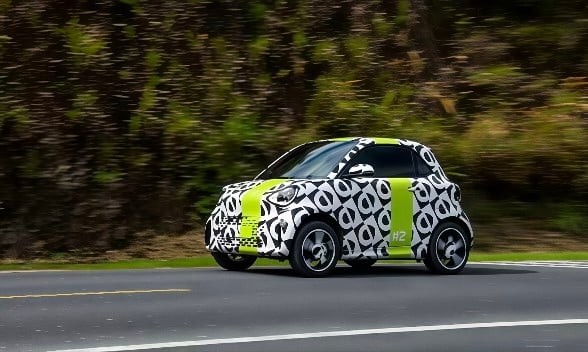
Camouflage clads the wheels. The car is moving.
Smart has officially kicked off global physical validation for the electric #2. This isn’t just a press release. The brand is rolling out pre-production units right now, months before the official production model debut slated for the Paris Motor Show in October 2016. Yes, the article says 2026. Stick with it.
You won’t see the finished product on public roads yet. You will see the prototype sweating through its paces.
Why the Smart #2 EV global testing phase matters now
Smart didn’t just toss these cars onto a track and walk away. According to the July 20 announcement from the brand, the validation program is brutal. It covers proving grounds. Wind tunnels. Acoustic chambers. Temperature-controlled four-post rigs that simulate every kind of road stress known to man. And public roads. Real asphalt. Real potholes.
The goal? Safety. Stability. Cabin refinement.
Yang Jun, the Smart Global CTO, put it plainly: they are checking everything before production begins.
The testing includes emergency lane changes. Wet-road conditions. NVH (noise, vibration, harshness) optimization. Kerb impacts. Deep-pothole durability evaluations. If you drive aggressively, they want to know how the #2 handles it. Smart hasn’t released specific numbers or independent validation data. They aren’t showing their cards yet.
Remember, early development happened in Northeast China during winter. Cold weather testing matters for batteries. The full list of global locations isn’t public. Names of facilities? Not disclosed.
How the Smart #2 EV design maximizes cabin space
Here is the twist. The all-electric #2 looks nothing like a traditional SUV. It looks like a box on wheels. But that box is intentional.
Smart says the production model carries over the space-maximizing DNA of the original Smart fortwo. Those little city cars from the 2000s? They packed a punch despite their size. Why? Because the wheels sit near the corners of the vehicle. This layout pushes the axles to the limit, leaving the center open for human passengers.
The result? Maximum cabin space. Minimum wasted footprint.
Under the skin, the #2 uses the Electric Compact Architecture (current validation work focuses on refining chassis hard points). We know it’s rear-wheel drive. It has a next-generation tridion safety cell—a structure Smart and Mercedes have perfected. The two-seat layout is clear.
They are tweaking steering ratio. Rack travel. Suspension movement control. Chassis rigidity. Structural stress points. Every bolt, every sensor, every micron is under the microscope.
What specs to expect from the production Smart #2 EV
The concept version gave us a glimpse. A 35.7 kWh battery. A WLTP range target of around 30 km? No, that’s too low. 300 km. That’s the WLTP figure. DC fast-charging from 10–80% takes about 20 minutes. Turning circle is a tight 6.95 meters.
Wait. Is 300 km enough?
For city driving? Yes. For cross-country? Maybe not.
But these figures applied to the concept. They have not been confirmed for production.
Smart CEO Tong Xiangbei previously described the #2 as production-bound and hinted at a 400 km CLTC (Chinese Light-Cycle Test) range target. Remember, CLTC ranges are often more optimistic than WLTP. This was an executive target, not a confirmed spec. Don’t bank on 400 km until it’s written in stone.
Development started earlier than you might think. First reports of testing appeared in December 2025, using modified fortwo-based test vehicles. Now we are in the pre-production phase.
When and where will the Smart #2 EV launch?
The Smart #2 isn’t alone in Smart’s 2026 lineup. It’s joining the Smart #6. The brand plans an expansion.
Smart has been operating as a global joint venture since 2019, with partners Mercedes-Benz AG and Zhejiang Geely holding the keys. This structure allows for rapid development but also keeps the final product tightly controlled.
The Paris Motor Show in October 21 is the deadline. But don’t expect the car to hit showrooms the next day. Validation takes time. Refinement takes longer.
Is the world ready for another small EV? The market is crowded. The #2 has a unique angle: pure electric, rear-wheel drive, and that corner-stepping footprint.
The testing continues. The camouflage stays on. We’ll know more when the Paris lights come up.