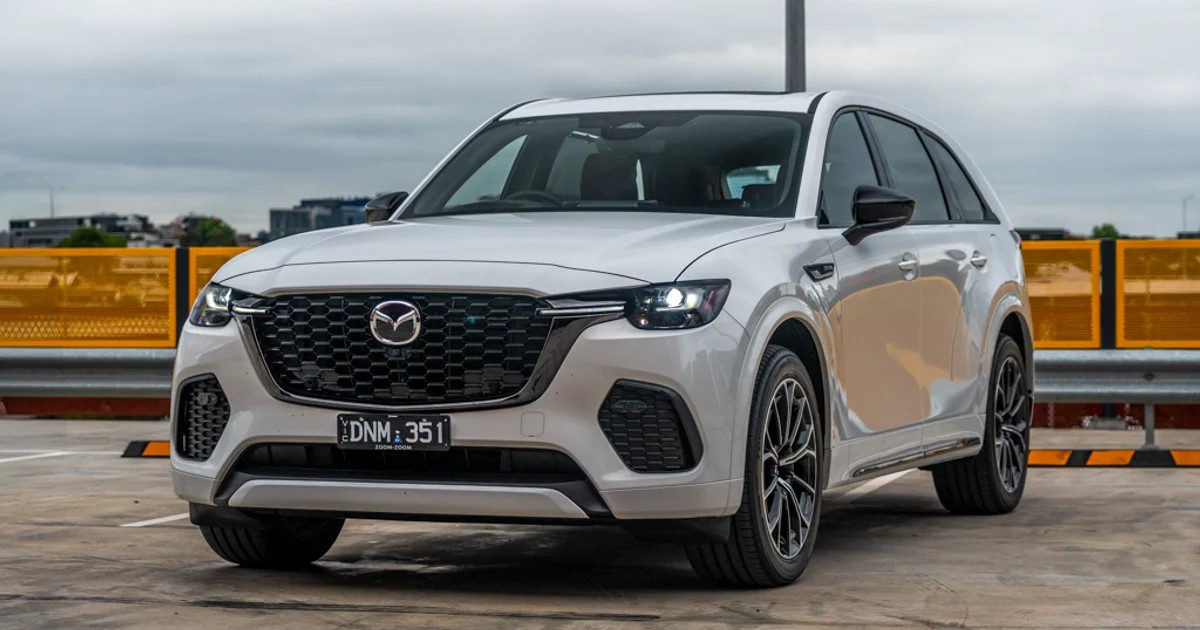
Mazda knows the CX-70 sells like molasses in January.
Slow sales don’t equal bad cars. But when you’ve pinned your premium expansion on a quartet of SUVs—CX-60, CX-75, CX-80, CX-90—and the math just isn’t adding up, it’s hard not to wonder if the product is missing something.
Mazda forecasted 1,400 monthly sales for this entire “Large Architecture” family back in late 2023. The plan was heavy: 550 for the CX-60, 60 for this niche CX-70, 650 for the roomier CX-80, and just 100 for the flagship CX-90.
Reality bit. Hard.
The CX-60 hovers around 500 units. The CX-80 sits in the 200s. Both the CX-70 and the CX-90 can’t even break the 40 mark per month consistently. The market has spoken. And it doesn’t care that the CX-70 shares a body with the more expensive, more spacious CX-90 while offering fewer seats. It just wants value, refinement, and competence. Critics say Mazda’s big SUVs lack differentiation. That they’re pricey. That the rides are too stiff and the gearboxes clunky. The numbers suggest the critics aren’t wrong.
Mazda wants 2026 to be different. Price hikes are already in place. No major changes are coming. So we test the most expensive version: the D50e Azami.
Does it justify its price? Is it better than the CX-90?
Pricing and Positioning
The D50e Azami diesel lands at $87,206 before on-roads costs. That’s a $2,046 bump since mid-202024.
For comparison, you could grab the same trim CX-90 for $80,00 more. Or go wider into the CX-80’s lane for less. Within the Mazda family, this is the outlier. Expensive for what you get.
Outside Mazda’s ecosystem? It’s pricey too. You’re looking at Toyota Kluger top-spec for $85k. Hyundai Palisade or Kia Sorento PHEV GT-Line hit similar $88-90k marks. Sure, Lexus RX, BMW X5, Audi Q5, Mercedes GLE sit well above $130k, but they’re luxury brands first. Mazda wants that halo. Can it deliver?
“Price isn’t just a number, it’s a promise.”
The promise here feels stretched.
Interior Design
The cabin is nice. Really nice, even. Real buttons, not a sea of glossy black capacitors. We love it. Climate control tactile feedback is instant, satisfying. It’s analog soul in a digital age.
The layout, however, is busy.
21 distinct physical buttons. All of them do stuff. Good luck finding them mid-drive unless you memorize the map. Then there’s the center console. Mazda insists on that rotary controller. It works. It’s just… not the first thing you’d expect in a premium vehicle. It requires muscle memory, some frustration, and frankly, it shouldn’t need touch-mode enabled by default to navigate CarPlay. Why force users to fight the system?
Still, once you get the hang of it, the armrest rests your forearm perfectly. It feels designed for someone who sits in that seat for hours. Steering wheel is meaty, wrapped in good leather. No cheap plastics in sight. Metallic accents tie things together. A bit American SUV, a bit Japanese precision. It’s spacious, yes, but is it premium enough?
The screen is a decent size, but pushed far away. Too far for comfortable interaction without leaning out. A slight design oversight.
Second row is massive. Legroom, headroom? Excessive almost. Rear doors open wide. Heating and cooling are separate zones for back passengers. A rare luxury. Panoramic glass roof helps the airy feeling.
Third-row? Well, it doesn’t have one. That’s where the cargo space wins out. Big trunk, usable, versatile. A bit of an annoyance that leftover CX-90 third-row seat belts or controls weren’t removed? True, lazy design maybe. But functionally it’s great for weekend Ikea trips.
Storage is adequate. Cupholders, door bottles, wireless charging pad tucked under climate controls. Middle seat hump? Massive. Anyone sitting center will be cramped. Skip that seat unless absolutely necessary.
Engine and Specs
Under the hood sits a 3.3L turbo-diesel six. Not much news here for Mazda enthusiasts, this platform shares this engine with the bigger CX-90. Outputs 180 kW and 450 Nm, assisted by 48-volt mild hybrid. Eight-speed auto, all-wheel-drive.
Efficiency is reasonable for diesel. Our week of mixed city, suburban, highway driving showed higher consumption than advertised. Still, better than the petrol counterpart? Yes, easily. Towing and long hauls prefer the torque of this mill.
Driving Impression
It starts. Rough idle typical of modern diesels? Check. But smooth running? Yes, once warmed up. Power delivery is linear. Torque feels abundant from low rpms. Hauls 2.2 tons without hesitation.
Transmission smoothness? Not smooth at all.
Harsh shifts in low speeds are frequent. The 8-speed auto acts like a dual clutch, or maybe a poorly tuned CVT. Hunting gears, hesitations, clunkiness when moving off slow. You feel the clutches slipping, catching, sliding. In stop-and-go traffic? An annoyance.
Is it undrivable? No. You learn its quirks. It adapts eventually, sort of. But luxury should feel seamless, not stuttery.
Ride firmness follows suit. Bouncy over bumps, unsettled on rough roads. Mazda defends it as “sporty tuning”, sure. But a premium SUV should isolate better. The CX-5 handles rougher, softer? Often feels better actually. Steering feedback remains sharp though, direct and communicative. You feel connected to front wheels, road. Fun in corners, if you like that side.
Road noise minimal, cabin refined. Good sound system Bose 12 speaker setup. Mi-Drive modes (Sport, Off-road, Towing) all behave logically. Towing mode notably stable for caravan towing.
“Fun isn’t the same thing as luxury, Mazda.”
That disconnect seems central here. It wants to drive sporty but cost premium comfort prices. Compromise rarely satisfies all parties.
Safety suite works without fuss. Lane keeping decent. Cruise control smooth. Blind spot monitors active. No complaints. Standard across the Azami top spec.
Trims and Options
Just two trims exist. GT, and Azami (plus optional Sport pack). Why simplify? Perhaps due to slow sales? Hard to know.
GT gets basics: heated mirrors, adaptive headlights, panoramic sunroof, HUD, 10-speaker audio. Azami upgrades to 18 speakers Bose, memory seating, ventilation front seats, higher roof finish touches, slight detail enhancements.
Difference isn’t night/day. Value proposition leans more toward GT, frankly.
Final Thoughts
Mazda built something competent, yes. Even desirable in spots. Design is attractive inside and out. Interior materials solid, layout interesting, seating plush. Ride dynamics firm but engaging, though compromised.
Transmission harshness and high pricing undercut enjoyment for many. Is this worth over $85k new? Debatable. Consider used options from year 1/2 possibly, wait for CX-30 to grow?
Wait no, that sentence trailed off. We’ll let that linger.
Mazda’s growth depends on proving its premium line has staying power, not just hype. CX-70 helps, slightly, but carries weight alone. It needs assistance from smoother shifts, better tuning, competitive pricing. Without change, niche remains narrow indeed.
You’ll either love it, hate it. Maybe even tolerate it. Only time, miles, and next updates decide which wins.