


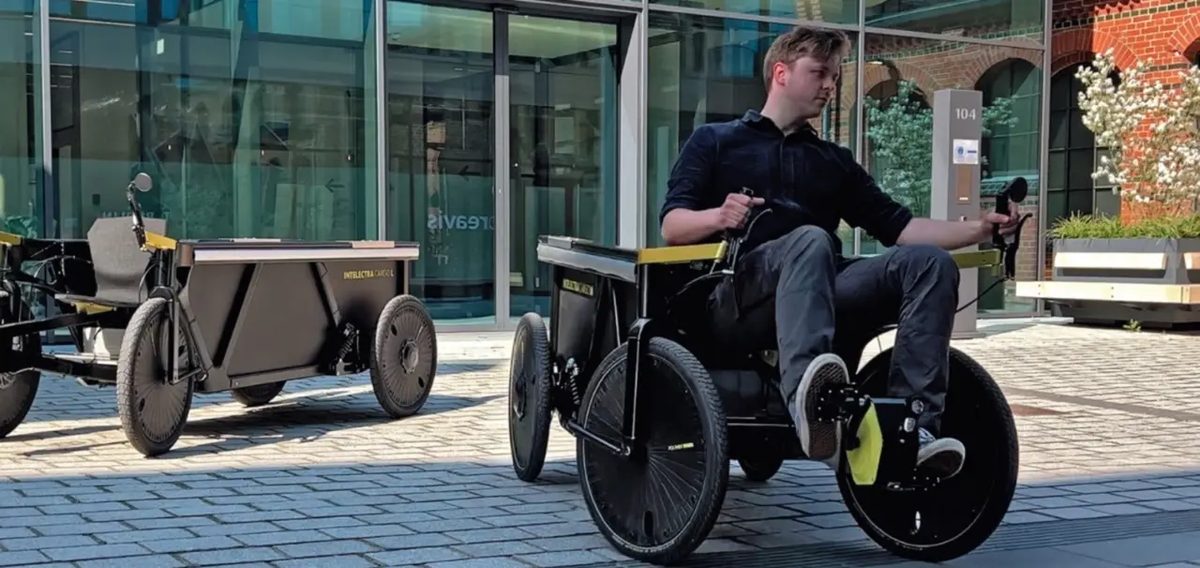
Most people can’t identify the Dynamic Drives Intelectra at a glance. And honestly, trying to categorize it is a waste of time. It is not a bicycle. It is not a car. It is not a trailer.
It is a German-made pedal cargo vehicle with four wheels.
The startup from Giessen built this thing to haul serious weight. We are talking about a payload capacity just shy of 450 kg. Throw in the vehicle’s own 122 kg curb weight, and you are moving nearly 600 kg of mass. You might think your legs would give out before you even left the driveway.
You would be wrong.
How the Intelectra’s Hybrid System Actually Works
Here is where the engineering gets weird. And I mean that in a good way.
Your legs do not turn the wheels.
When you pedal, you are essentially acting as a human generator. The energy from your crankset is converted into electricity, pushing out up to 250 watts of power. This does not drive the axles directly. Instead, it charges the 1,400 Wh battery pack mid-ride.
That battery is the real muscle.
It powers two 125-watt hub motors located on the rear axle. That is 250 watts of electric torque coming straight to the ground. An intelligent controller reads your pedaling cadence. Pedal faster? The controller signals the motors to spin harder. You get immediate acceleration feedback. It feels like riding, but with the punch of a small e-bike.
Range and Regen Braking
You are not locked into relying solely on your quads. The battery can be plugged in and fully recharge in roughly ninety minutes. From there, the Intelectra offers an estimated range of 93 kilometers.
That is plenty for urban logistics or heavy commuting.
The system also handles energy recovery. When you brake, the motors act as generators again. They push energy back into the battery. It is a closed loop of sorts. You pedal to charge, the battery drives the wheels, and braking tops the tank off again.
It is a clever workaround for the limitations of human power. You get the exercise without the exhaustion. You get the cargo capacity without the diesel fumes.
Does it look like a spaceship landing in your driveway? Probably.
But when you are hauling 450 kg of goods through city traffic, aesthetics take a backseat to utility. The Dynamic Drives Intelectra proves that sometimes the best way to move heavy things is to let an electric motor do the heavy lifting while you just keep the rhythm.
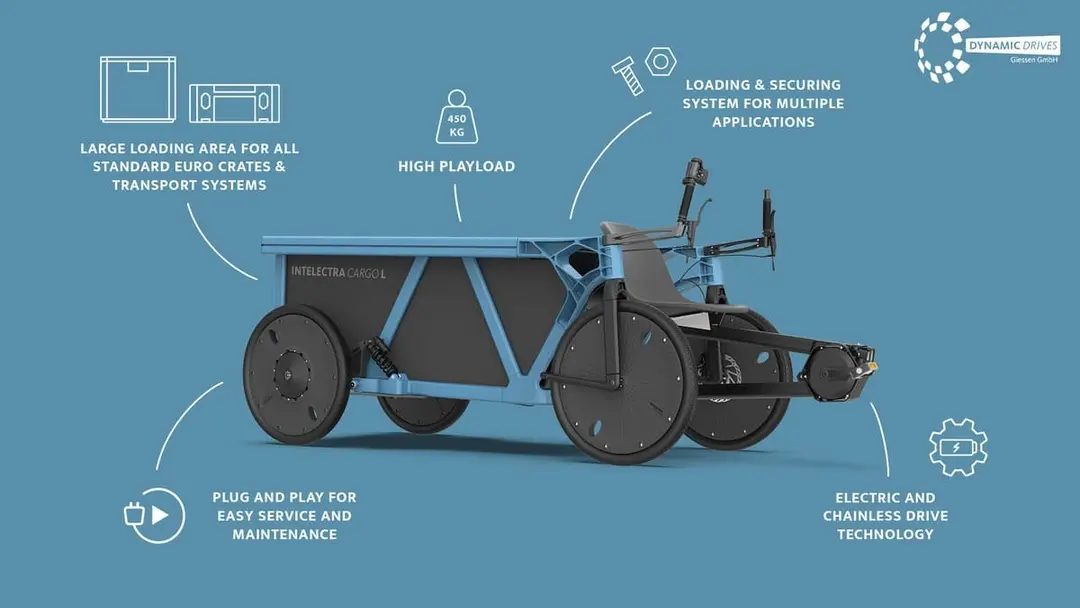

Rear wheel drive regenerative braking
This layout overturns everything you know about delivery vehicles. The driver sits in front. The trunk is located at the back and is huge and reinforced with aluminum. You can control the seat with the handlebars on either side. This is not a car. This one is heavier. If you order the right option, the roof will look like something from a spaghetti western.
Regenerative braking is the star here. No chain. There is no belt. No gear wear. The manufacturer claims that maintenance is almost zero. Driven 30,000 km without tools. This is unusual for any vehicle, let alone one designed to squeeze into the wheel space.
The speed limit is 25 km/h. It’s not because the motor can’t go fast, it’s because the regulations consider it a heavy e-bike. Narrow roads are not suitable for speeding anyway. They reward accuracy. This suspension has precision. The damping of the rear part is adjusted according to the load. Empty? soft. Full load? Harder. It just works.
Pricing and Availability
Sales will start this fall. The basic price is 9,250 euros. But it’s just a skeleton. Requires 1-2 batteries. Maybe a passenger seat. Or a canopy. The canopy looks like a horse carriage. That’s the point.
It replaces traditional delivery trucks. However, it is limited to small spaces. A place where trucks cannot pass. Where speed doesn’t matter. Urban planning forgot about logistics, leaving behind cobblestone walkways and narrow alleyways. This car thrives in chaos.
It’s not fast. It’s not flashy. This is very practical. In cramped, suffocating cities, practicality takes precedence. every time.
The delivery is tight. The price is also obvious. The options are modular. It’s not a question of whether it works. The question is whether your city allows you to drive where you want to go.


