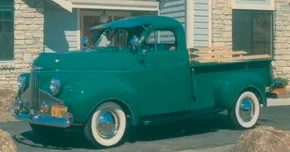
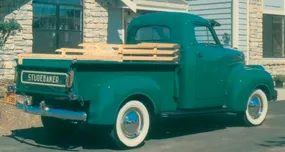
The post-war truck market was a bloodbath. Ford, Chevrolet, and Dodge were all swinging for the fences, yet the 1947 Studebaker M-5 Coupe Express held its ground. It didn’t win by being the loudest or the biggest. It won by being smart.
There is a common misconception that Studebaker’s “Coupe Express” line was always a car-pickup hybrid. That was true for the 1937-1939 models. Those early attempts were essentially sedans with flatbeds stapled to the back. But the 1947 M-5 Coupe Express (note the lack of a hyphen) was different. It descended from a lineage of real, industrial trucks.
Studebaker had re-entered the truck arena in 1941. They didn’t half-ass it. They launched the M5 family, a robust range of 1/2- to 1 1/2-ton workhorses. With wheelbases stretching from 113 to 195 inches, this lineup covered 90 percent of the available truck market. It was a serious business move.
The Secret Was in the Shared Parts Bin
How did a relatively small player like Studebaker compete with the Big Three? Profit margins. The entire truck revival was bankrolled by sales of the Studebaker Champion passenger car, which had saved the company from financial ruin starting in 1939.
The genius of the M-5 Coupe Express lay in its engineering. While it was a genuine truck under the skin, it borrowed heavily from the car division. This strategy slashed tooling costs to near zero.
Under the hood, you found the Champion’s 170-cid L-head six-cylinder engine. It wasn’t a monster. It produced 80 bhp. That was plenty for a half-ton payload, though it certainly wouldn’t win any drag races. The dashboard came straight from the passenger car. So did the steering wheel, some body panels, and the headlamp rims. Even the hubcaps were lifted from the Commander model.
Sharing components wasn’t just about saving money; it gave the M-5 a familiarity that car buyers already trusted.
DeLuxe Trim and Post-War Perks
Base models were spartan. They had to be. Trucks were tools, not toys. But for an extra $25, buyers could option the “DeLuxe Equipment Group.”
This upgrade added brightwork to the grille and hood. It swapped out the standard black fenders for body-color ones. You got a chrome driver’s side mirror, a hood ornament, and an interior light.
The rest of the options list was where Studebaker tried to mimic the consumer appeal of the Big Three. You could add bumper guards, a grille guard, a chrome rear bumper, a spotlight, foglamps, a radio, and even whitewall tires. It was a strange mix of rugged utility and suburban vanity.
Civilian production had halted for the war effort, but by 1947, factories were roaring. The M-5 Coupe Express alone saw output exceed 23,000 units. Total M-series production topped 52,000.
The sticker price was $1,082. That’s steep for a truck, but consider what you got. Compared to pre-war models, changes were minor. A spare tire was now standard issue. The options list was slightly expanded. In fact, the hood ornament, which had cost $4.75 extra before the war, became standard equipment from mid-1947 onward.
A Disappointing Finale
The 1948 model year brought virtually no changes. Why? Because the M-5 was scheduled for death. Studebaker had a new postwar design ready to roll off the line in March 1948. The M-5 was a stopgap. A bridge.
For collectors, the M-5 Coupe Express is a mixed bag. It has its pluses. Some argue it boasts the most beautiful dashboard on any classic truck. The exterior styling holds up well. There is a strong enthusiast community behind it, and parts are
The journey does not end here. If you’re looking for more visual content or want to dive deeper into the world of new and classic trucks, the way is open for you. See Classic Trucks for classic and vintage vehicles. Do you want current market information and the latest comments? Visit Ford Trucks for the latest Blue Oval news and Consumer Guide Auto Reviews and Prices for unbiased and intelligent analysis of true value for money.