There aren’t many six-figure utility vehicles left that refuse to pick a lane.
A Cadillac Escalade? That’s presence. Pure and simple.
A Lincoln Navigator majors in plush comfort.
A Chevy Suburban exists for pure hauling utility.
Even the Range Rover, which tries to blend high-end luxury with off-road grit, demands an eye-watering sum for that duality.
Then there’s the 2026 Jeep Grand Grand Wagoneer. It doesn’t just try to be everything; it aggressively pursues every role at once. Three rows of serious luxury? Check. The ability to wander miles off pavement and then cruise home on the interstate without throwing a tantrum? Double check.
This is a bold claim for a vehicle that clocks in at nearly 18 feet in length and tips the scales at nearly three tons.
Jeep shook things up for 2026. The standard Wagoneer is dead. The potent 540 horsepower High Output Hurricane inline-six has retired to a museum. Now, every Grand Wagoneer ships with the “standard” twin-turbo 3.0-liter Hurricane. It pushes 420 hp and 468 lb-ft of torque. On paper? Feels like a cost-cut. In reality? It’s complicated.
After spending a week with this beast—actually driving it somewhere most buyers wouldn’t think twice about taking—the main takeaway was weird. What do you do when the best vehicle in its class is also the one you’d recommend less?
Design: A Tale of Two Ends
When this generation first arrived, it felt disjointed. Jeep seemingly designed the front fascia and rear bumper in two different time zones and bolted them together five minutes before shipping. The nose looked modern. The rear looked like an overinflated appliance from 2015.
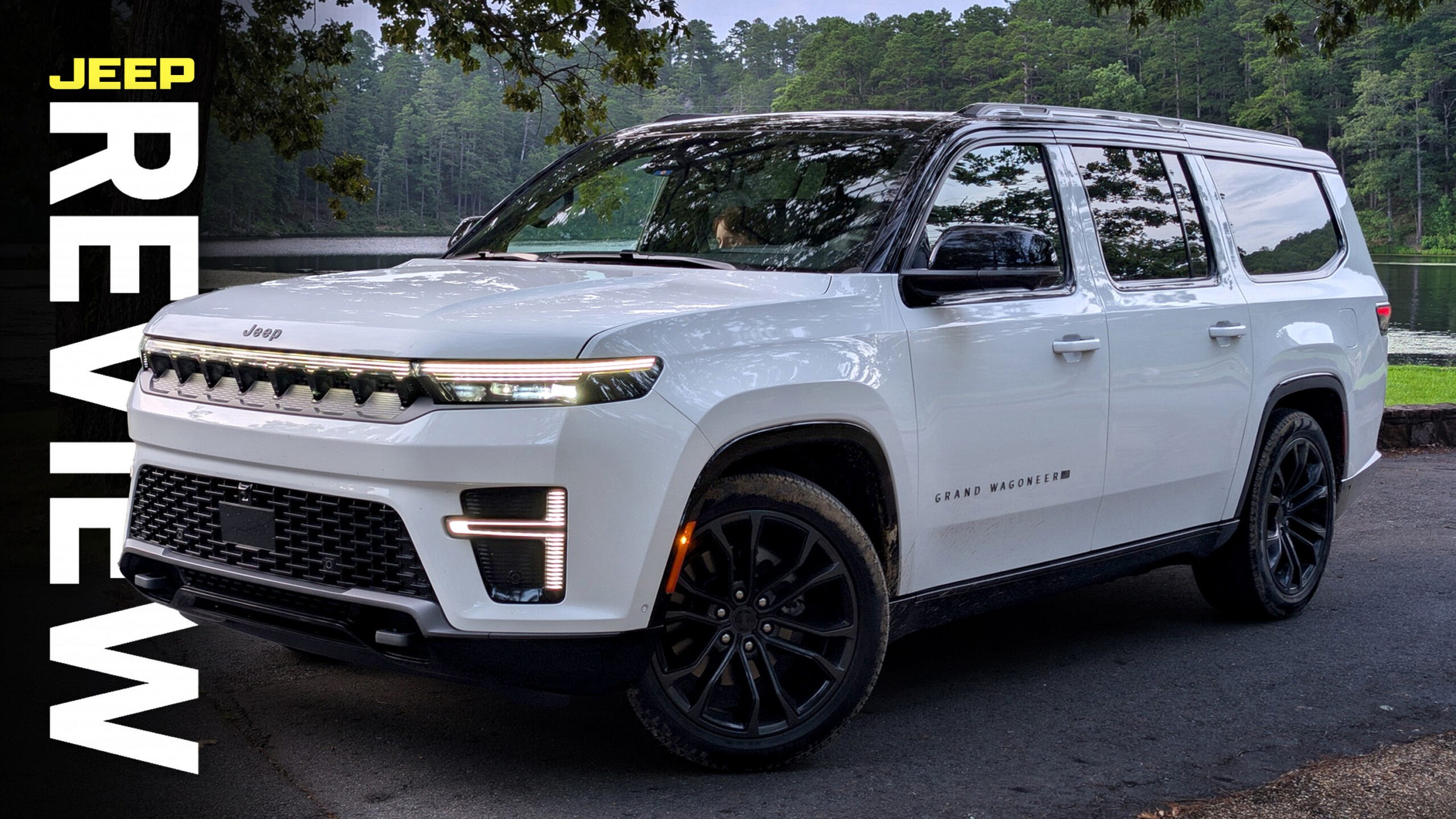
The 2026 facelift fixes half the problem. The front finally looks like a Jeep. Slimmer lights, a refined grille, cleaner surfacing. You recognize it from a half-mile away. That’s what a flagship needs.
The back? Still struggles. The proportions feel bloated. Viewed behind the C-pillar, the design seems to have kept expanding while other designers put their pens down. If the front is an athlete, the rear is… well, let’s talk whales.
Painting this giant in white makes it look even longer. And heavier. Metaphorically speaking, it reminds me of the beluga whale. Why? Because adult belugas are about 15 feet long. This Jeep is 17.8. There’s a random fact to impress your friends at the grocery store.
At least the 2026 Grand Wagoneet styling works on the proportions of the massive 22-inch wheels. They don’t disappear, nor do they dominate. They look just right. Overall? This is the best-looking version yet. But the rear remains the weak link.
Inside: Expensive Plastic and Great Massage Chairs
The interior justifies much of that $100k+ price tag. Most of the time.
Find the cheap stuff, and it’s there. The piano black plastic on the console and dash looks and feels wrong in a vehicle of this caliber. It scratches. It attracts fingerprints like a magnet. Eventually, it’ll look worn.
But touch almost anywhere else, and it feels premium. Quilted leather. Stitching that implies cost. Even the start/stop button feels like something you actually pay attention to.
Stretch across the dash? Textured wood trim. The Grand Wagoneer script on the passenger side is elegant. One of the classiest interiors in American auto manufacturing right now.
The seats are the highlight. Heated, ventilated, and massaged. Not those annoying buzz-vibrations that just numb you out. Real massage. After hours behind the wheel, my shoulders thanked me.
They’re designed for someone 6’5″ or shorter, though. I’m 6’6″. My headrest didn’t perfectly align with my shoulders. I couldn’t adjust the upper back perfectly to meet it. The massage chair compensated, barely.
Here’s the flaw: Jeep installed a row of sensitive electronic switches directly below the cupholders.
Think about it. How long does it take for coffee, soda, or a leaking water bottle to touch those switches? Gravity is ruthless. Expensive SUVs or not, spillage is inevitable. Replacing that control module is likely a wallet-slice scenario most owners don’t plan for.
Fortunately, the main screens are smart. Responsive. Jeep kept physical climate controls—a smart move. A second, lower retractable touchscreen handles seats and hides away wireless charging, USBs, and an HDMI port. The passenger display? Functional but overly complex. Using it is harder than it needs to be. You have to pair headphones, link apps, and pray for synergy. Sometimes, the passenger is just better off watching what’s playing on the main rear screens.
Rear Seats: Where It Shines
The second row? Probably the best place to sit.
Heated/ventilated captain’s chairs. Lots of legroom. Four USBs. A household power outlet. Two huge entertainment screens. First class.
Third row? Surprisingly good.
Aside from the Grand Cherokee L, can you name another full-size SUV with a usable third row? Adults fit here. The leather is decent, not a throwback afterthought. Outboard passengers get power recline and their own cupholders and storage.
Cargo is solid:
– 28.4 cu-ft (behind row 3)
– 70.8 cu-ft (row 3 down)
– 94.2 cu-ft (row 2 down)
And thanks to power-folding seats, rearranging isn’t a workout. A feature surprisingly rare among similarly priced American haulers.
Oh, and the audio? The McIntosh sound system in the Grand Wagoneet 2026 specs is spectacular. Not “good for an SUV.” Spectacular. Probably the best factory audio system available in mainstream luxury right now.
On the Road and Off It
The cabin is nice. The driving dynamics? That’s the differentiator.
I’ve driven the Escalade IQ. The Suburban. The Expedition. None of them glide like the Wagoneer. It reminds me of a Range Rover, minus the cornering finesse. It lacks body roll for something weighing ~6,400 lbs. The steering is accurate. The ride is silent. Wind? Minimal. Road noise? Barely there.
This thing weighs twice as much as a beluga whale. It should not handle like that. But it does.
The 420-hp Hurricaine engine is… fine. It’s fast. Passing is effortless. Towing capacity holds up at 9,810 lb. Most people won’t notice anything missing. But if you drove the old 540 HP version? You’ll miss that extra urgency. This isn’t an unnecessary downgrade for most. But it loses a bit of the “fun” factor.
Fuel economy? We saw 15.4 mpg. The EPA estimated 18 combined. Yeah, the luxury tax includes your wallet, too.
Off-Road Capability
I took it off pavement. Not rock crawling. Not bogging. Just severe trails. Steep grades. Deep ruts.
At one point, the passenger front tire hung off the ground. The suspension hit max articulation.
Did it panic? No. The Jeep kept going. Smoothly. Without drama. Without hesitation. It’s easy to forget: this is a Jeep. Just… a really wide Jeep. Two-way forest roads are not built for 80-inch-plus widths. If someone had come around the bend, there would have been a massive backup situation.
The Verdict
Is the 2026 Grand Wagoteer L the best full-size luxury SUV?
In many ways, yes. Better looking. Better handling. Interior that punches above its weight. Capable off-road in its class.
But should you buy one?
I might buy a Grand Cherokee L instead.
– Smaller footprint. Easier to drive.
– Goes even further off-road.
– Nearly identical interior quality.
– Still has a usable third row.
– Costs significantly less.
Need the extra tow capacity or cargo volume? Look for a Certified Pre-Owned Grand Wagoneet. Hunting down one with the 540 HP High Output or even the V8. Save tens of thousands. Keep it under warranty. Get a more exciting powertrain.
New six-figure cars are hard to justify when you occupy more road than pedestrians and pedestrians might miss. Visibility is tricky. Infrastructure groans.
Still? If you want the biggest, boldest, most complete luxury hauler on sale? It’s this.
But I’ll likely tell you to buy the smaller sibling. Unless, of course, you absolutely need those extra inches of cargo and seats. In that case? Nothing beats the Wagoneet.
Just don’t spill your coffee. Not near those switches.