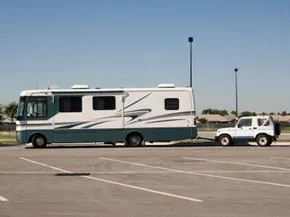
It was September 2007. A parking lot outside a Philly restaurant. A driverless RV, trailer in tow, decided to leave the premises. It slipped out of gear and crept into the street at roughly 5 mph (8 km/h). A Volkswagen Jetta was doing 35 mph (56 km/h) when it crossed the RV’s path.
Collision. The Jetta got hammered. Driver went to the hospital. Not seriously injured, by the grace of good luck and seatbelts. Police cited the sheer mass of the RV-trailer combo as the culprit. Nobody was happy. It’s a solid bet that the driver of that RV wished the universe would just swallow it whole.
Accidents involving recreational vehicles are nasty business. The size difference between a sedan and a 20,000-pound beast creates a physics problem that seatbelts alone can’t always solve. If you’re thinking about hitting the road with a trailer or towing a car behind your camper, you need to understand the rules. Not just the laws, but the mechanics.
The Knowledge Gap
You might tow a fifth wheel to get there, or pull a “dinghy” car to drive once you park. Either way, you are managing a massive liability.
Here’s the thing. Driving a rig the size of a tour bus requires skill. It requires the same level of knowledge as a commercial truck driver. Yet, most states don’t require you to have a Commercial Driver’s License (CDL) or special certification. You’re on your own.
How do you learn to handle the sway? How do you calculate the weight distribution? You don’t get it handed to you. You have to seek it out. This guide covers the basics. It’s not a substitute for professional training. But it’s better than nothing.
RV Weight Safety
Weight is not a suggestion. It’s the law of physics, written in steel and rubber.
Gross Vehicle Weight Rating (GVWR)
Every RV comes with a sticker. It lists the Gross Vehicle Weight Rating. This is the maximum safe weight for the vehicle when fully loaded. Fuel, water, passengers, cargo, propane. It all counts.
If your loaded RV exceeds the GVWR, you’re playing Russian Roulette with your brakes and frame. The suspension sags. The tires overheat. The handling becomes unpredictable. Don’t do it.
Gross Combined Weight Rating (GCWR)
This is the big one. GCWR is the maximum allowed weight of the towing vehicle plus the trailer plus everything in both.
Most people look at the truck’s tow rating and stop there. That’s a mistake. You need to know the GCWR of the towing vehicle. If you’re towing a heavy fifth wheel, your half-ton pickup might not cut it once you factor in the passengers and cargo inside the cab.
Check your owner’s manual. Look for the Gross Combined Weight Rating. If your total setup exceeds this number, you risk catastrophic failure of the drivetrain, transmission, or brakes.
Tongue Weight and Hitch Types
How you attach matters.
- Bumper Pull: The trailer attaches to a hitch on the rear bumper or frame. Simple. Common for travel trailers. But prone to sway if not loaded correctly.
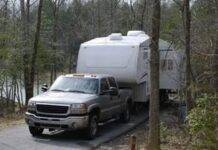
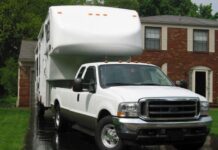
- Fifth Wheel: The hitch is in the bed of the pickup truck. This puts more weight over the rear axle of the tow vehicle. Better stability. Less sway. Requires a specific hitch and a truck with a bed.
Tongue weight should be 10-15% of the trailer’s total weight
Overloading isn’t just a ticket. It’s a death trap.
When you hook up a fifth wheel or tow an RV, the physics don’t care about your vacation plans. They care about mass. Inertia. Friction.
Most folks think they’re fine until they hit a hill and the engine screams. Or worse, they hit the brakes and realize their stopping distance has doubled. The solution? It’s not buying a bigger truck. It’s understanding the numbers on the sticker.
You need to know your vehicle’s weight capacities. And then you need to respect them.
The Glossary of Disaster Prevention
Let’s strip away the marketing fluff. Here is what these acronyms actually mean for your safety on the road.
Tongue Weight
This is the downward force the trailer exerts on the tow vehicle’s hitch. It’s not just “extra weight.” It’s the critical pivot point for stability. Get it wrong, and you invite sway.
Gross Vehicle Weight Rating (GVWR)
This is the hard ceiling. The manufacturer tells you the maximum safe weight for the RV itself. This includes the rig, passengers, fuel, water, cargo, AND the tongue weight of whatever you are towing behind it. Check the placard inside your door frame. That number is law. Exceed it, and you are playing Russian roulette with your suspension and frame.
Gross Axle Weight Rating (GAWR)
This applies to each axle individually. Even if your total weight is under GVWR, you can still blow out an axle if the weight distribution is off. Measure at the wheel. Respect the limit.
Dry Weight vs. Curb Weight
Dry weight is the RV with zero fluids, zero cargo, zero people. It’s a marketing number. Useless for real-world safety.
Curb weight includes fuel, oil, and coolant. It’s closer to reality, but still missing the human element.
Gross Combined Weight Rating (GCWR)
This is the total weight of the tow vehicle plus the trailer. Don’t confuse this with GVWR. GCWR is the combo. If you exceed this, you aren’t just damaging the RV; you’re likely overheating the transmission and straining the tow vehicle’s drivetrain to the breaking point.
Net Carrying Capacity (NCC)
This is your usable payload. Calculate it by taking your GVWR and subtracting your Curb Weight. The result is everything else you can load in: passengers, gear, water, and that extra tongue weight. Ignore this math, and you will exceed your GVWR. You will guarantee it.
How to Weigh Your Rig Without Guessing
You have a loaded RV. You have a loaded tow vehicle. You have no idea if you’re legal.
Go to a scale.
Public scales exist. Truck stops often have them. Look for “Public Scales” in local directories or search online. There is a small fee. Pay it. It’s cheaper than a new frame.
Weigh the tow vehicle alone. Weigh the trailer alone. Weigh the combined unit if possible. Compare those numbers against your GVWR, GAWR, and GCWR.
If you are over, you have to unload. There is no workaround.
The Physics of Overloading
You might think, “It drove fine yesterday.”
That’s how accidents start.
Overloading doesn’t always cause immediate catastrophic failure. It causes gradual destruction. The suspension sags. The brakes overheat. The frame flexes beyond its tolerance. The engine works at 100% load just to maintain highway speeds.
But the immediate danger is inertia.
An overloaded rig has massive momentum. When you need to stop, your brakes are overwhelmed. You are not stopping when you think you are. You are sliding. On a downhill grade, this is fatal. The tow vehicle’s brakes may fade completely. Even if they hold, your stopping distance increases drastically. You could plow into the vehicle in front of you. Or worse, jackknife.
Uphill, the penalties are different but equally ruinous. You might stall out on an incline. You might overheat the transmission. You might blow a tire at 70 mph. A blown tire with a heavy trailer is a loss of control event that rarely ends well.
Balance Is as Important as Total Weight
Keeping the total weight down is step one. Distributing it is step two.
Poor balance destroys handling.
If your weight is skewed to one side, you lose steering control. The vehicle pulls. You fight the wheel. Fatigue sets in. Braking becomes uneven. One side grabs, the other slides.
If your weight is front-heavy or rear-heavy, you invite trailer sway.
Experts recommend side-to-side balance and front-to-rear balance. But specifically, watch your tongue weight.
For standard bumper pull trailers, tongue weight should be 10 to 15 percent of the total loaded trailer weight.
For fifth wheels, the hitch handles much more. You can often aim for 20 to 25 percent of the trailer’s weight.
Why does this matter? Because the hitch is the steering point. Too little tongue weight? The trailer floats and sways. Too much? You overload the rear axle of the tow vehicle, causing front-end lift and poor steering response.
Maintain proper axle weights based on your GAWR. Check them. Adjust your cargo. Move heavy items to balance the load.
The Bottom Line
You are responsible for the physics.
The manufacturer sets the limits. You enforce them.
Don’t ignore the placard. Don’t guess the weight. Use the scales. Calculate your NCC. Distribute your cargo.
If you skip this step, you aren’t just risking your rig. You are risking your life and the lives of everyone else on that highway.
The next step is the checklist. Are you ready?
Read the next page for the RV Towing Safety Checklist to ensure you’re actually prepared for the road.
Why RV Towing Safety Training Matters
You wouldn’t drive a semi-truck without certification. So why skip the basics when hauling a travel trailer? RV driving schools exist for a reason. They teach you how a heavy rig behaves before you’re stuck on I-95 with traffic breathing down your neck. If the course covers towing specifics, take it. It’s not just about getting a certificate. It’s about learning to respect the physics of a vehicle that weighs as much as a small house.
Practice Before You Commit
Stop and think about your last time backing a trailer. Or even your first.
If you have zero experience, find an empty parking lot. Practice parking. Practice steering. Practice braking. You need to feel how the RV and trailer handle together. Once you hit the road, you won’t have the luxury of time to figure it out.
Pre-Tow Inspection Protocol
Before you even think about hitting the gas, check the fundamentals.
- Ground Level: Hooking up a fifth wheel or travel trailer on a slope is a nightmare. If the ground isn’t level, the trailer can roll away before the hitch is engaged. Use chocks.
- Lights: Check every single light. Headlights, taillights, turn signals, marker lights. Both the tow vehicle and the trailer need to be fully operational.
- Tires: Inspect tread depth. Check inflation pressure. Underinflated tires on a loaded rig can blow out in seconds.
Load Security and Visibility
Tie down everything loose. When you hit a bump or make a sharp turn, loose objects become projectiles. Don’t let your cookware or gear become a hazard.
Visibility is another big issue. Your tow setup takes up serious space. You aren’t just driving a car anymore. You’re driving a mobile fortress.
Driving Dynamics: Hills and Braking
When climbing or descending, choose the right gear. Lower gears provide more power for climbs. They also help slow the vehicle’s descent without relying solely on the brakes.
Braking is where most rookies fail.
Don’t ride the brakes all the way down an incline.
If you keep the foot on the pedal, the brakes will overheat. They will fade. They will fail. Downshift instead. Let the engine help you slow down. Give yourself extra stopping distance. Momentum is your enemy. Even the best brakes can’t stop a heavy rig as quickly as you’d expect.
Emergency Preparedness
What happens if something goes wrong?
Carry a first-aid kit. A fire extinguisher. A flashlight. A toolkit. A cell phone. And a battery charger for that phone. You never know when you’ll need help.
Insurance matters too. Make sure your policy specifically covers towing another vehicle. You might need special RV towing insurance. Keep that information in the glove box. Not in the back of your mind.
Avoiding the Backing Trap
Back up as little as possible. It’s hard. It’s dangerous. If you absolutely must reverse, get someone outside. Have them guide you with hand signals. Don’t rely on mirrors alone. They distort distance.
The Bigger Picture
This is just the start. You need to understand regulations. How gross trailer weight works. Tongue weight. Transmission coolers.
- How RV Towing Regulations Work
- The Advantages and Disadvantages of RV Towing
- How RV Hitches Work
- How Gross Trailer Weight (GTW) Works
- How Tongue Weight Works
- What is base curb weight?
- How do truck weigh stations work?
- Green Towing: Is there a green way to tow?
- 10 Tips for Easy Towing
- How to Tow a Two-wheel-drive Vehicle
- How to Tow a Four-wheel-drive Vehicle
- Top 10 Towing Risks to Keep in Mind
- How Transmission Coolers Work
- How Trailer Towing Safety Works
- How Tie-down Hangers Work
- Using Mirrors While Towing
- Passing While Towing
- Shifting While Towing
- Braking While Towing
- How to Turn While Towing
- RV Towing Regulations Quiz
For deeper dives, check out the RV Safety & Education Foundation. Or Funroads.com. RVers Online has practical tips too.
Sources:
– Funroads.com. “RV Travel Safety Tips.” (Nov. 19, 2008)
– Greig, Peter M. “Weights & Balance For RV’ers.” RVers Online. (Nov. 19, 2008)
– McLellan, Ivan P.W. “Notes.” Ivan’s NZ Photographic Web site. (Nov. 19, 2008)
– Ruvo, Christopher. “Empty RV rolls onto highway.” The Intelligencer. Sept.13, 2007.
– RV Basics.com. “RV Fifth Wheel & Travel Trailer Towing Safety Tips.” (Nov. 19, 2008)
– RVers Online. “Practical Tips For Towing.” (Nov. 19, 2008)
– Walter. “RV Safety & Education Foundation Pre-Trip Safety Checklist — Motorhome.” Feb. 7, 2007.